


Exploring the multifaceted landscape of the UK construction industry in 2024, this article delves into challenges and obstacles that companies may not be ready for.
The UK construction industry, a vital cog in the nation’s economic engine, currently stands at a crossroads of progress and challenge. In 2023, inflationary pressures — whether caused by “stagflation” or “greedflation” — were arguably the sector’s biggest roadblocks. Inflation, in turn, has affected clients, contractors and the supply chain by increasing consultation fees, material, energy, labour costs and equipment rental rates.
But it wasn’t all gloom and doom. In 2022, predictions indicated that certain segments of the construction industry would face significant challenges navigating a complex array of economic difficulties. But contrary to these forecasts, the industry has demonstrated remarkable resilience amid stagnating demand, and many of the negative outcomes anticipated last year have not occurred.
As we enter 2024, companies in the UK construction industry can expect a better outlook than last year. According to construction insights firm Glenigan, 2024 and 2025 will see the sector grow by 12% and 3%, respectively. Challenges remain, however, and both contractors and clients will need to navigate a complex landscape shaped by skills shortages, inflation and evolving regulatory environments. We take a closer look at these potential obstacles and how companies can overcome them.
Related Reading: Supply Chain Risk Management Issues To Look Out For In 2024
1. Labour Shortages Continue
Source: Financial Times
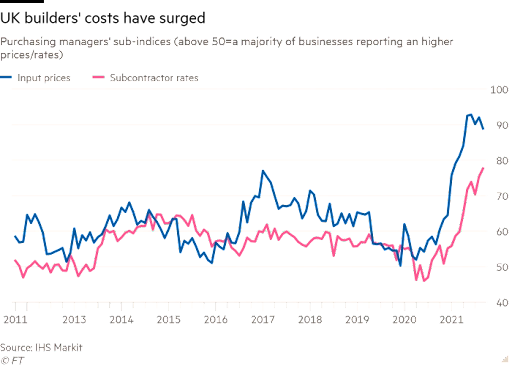
For years, the UK construction industry has grappled with a labour shortage — a situation exacerbated by a confluence of sociopolitical and demographic factors. Construction workers now find their services in high demand, but for housing companies and construction firms, the skills shortage has led to higher builders’ costs.
The aftermath of Brexit plays a pivotal role in this challenge, as the industry, once reliant on a substantial influx of skilled workers from the European Union, now faces a stark reduction in this essential labour pool. This shortage is further compounded by an ageing workforce, with a considerable portion of skilled tradespeople approaching retirement age and insufficient numbers of younger workers stepping in to fill these roles.
Related Reading: The Ultimate CHAS Guide To Managing The UK’s Skills Shortage Problem
In response to this crisis, the government announced the addition of five construction occupations to the Shortage Occupation List (SOL) last year. However, it remains to be seen whether the SOL has had a significant impact on remedying the diminishing workforce in construction. Whatever the case, organisations need to devise policies that emphasise a long-term approach to the skills shortage, focusing on investments in apprenticeships and training.
2. Housing Downturn Due To High Inflation
Despite the lack of concrete policies to stimulate capital investment, the UK economy has avoided a recession. In fact, ONS figures show that the GDP grew by 0.6% and construction output by 0.1% in Q3 of 2023 compared to the same period a year ago. However, new work output is expected to drop by over 1% in 2023.
Inflation has decreased to 6.1%, lower than the predicted 6.6% but still much lower than last year’s 12.8%. Interest rates remain high at 5.25%, influencing a decline in industry demand. EY Parthenon reports that rising interest rates are now the main concern, with credit-related warnings at their highest since 2008. This has particularly affected the housing sector, experiencing a downturn not seen since the global financial crisis.
ONS data revealed a 2.8% decrease (£260 million) in new private housing work in Q3 2023 and a 13.4% drop compared to the same period in 2022. The outlook for next year is bleak, but growth is expected in 2025. The government’s target of 300,000 homes per year remains unmet, highlighting the need for effective measures to address the housing crisis.
3. Another Wave Of Building Safety Reform
The previous year saw the construction sector adjusting to updated building safety regulations in England and Wales. In October 2023, the primary provisions of the Building Safety Act 2022 came into effect, introducing significant changes to the design, construction and oversight of “high-risk” buildings.
But this is just the initial phase of the legislation’s implementation. Further changes, including the reform of the building control system, are set to be implemented later this year. On 6 April 2024, approved inspectors will need to apply to register with the Building Safety Regulator (BSR) to continue working as a registered building control approver (RBCA).
This date is also a critical month for in-scope buildings whose construction began before 1 October 2023. In cases like these, transitional agreements apply to individual construction projects to be completed under the current procedural rules and the existing approved inspector, provided they meet certain conditions, such as that work must be “sufficiently progressed” before 6 April 2024.
Related Reading: What Are The Key Updates To The Building Safety Act In 2023?
Keep Up With Changes In The UK Construction Industry With CHAS
One way to navigate these changes is to ensure you understand the risks present in your construction supply chain. Veriforce CHAS can help your organisation by guiding your contractors through the latest changes in regulations and compliance requirements. As a CHAS Client, you’ll get everything you need to upgrade your compliance levels under one roof.
Are You Ready To Be A CHAS Client?
Sign up for FREE today or learn more about our client services by scheduling a callback with one of our friendly CHAS advisors.

