


Risks and hazards are part and parcel of any workplace, and mitigating them is critical to creating a safe environment and preventing the risk of injury or harm to employees, visitors and the general public. But to prevent workplace incidents, it’s vital to understand what risks and hazards are.
We explain the differences between risks and hazards, share examples of each, and explore best practices for identifying them, the importance of documenting risks and hazards and how to manage and review them to maintain a safe environment and ensure compliance with health and safety regulations.
What Is A Hazard?
A hazard is anything that could potentially cause harm or damage. Hazards can be:
- Physical, such as a confined space, machinery or loud noises.
- Biological, like bacteria or viruses.
- Chemical, including acids, solvents or pesticides.
- Ergonomic, which relates to the design of a workplace or the way employees work. Examples include sitting on a chair without adequate back support or lifting heavy objects in a way that weakens posture.
- Psychological, including fatigue and stress, lack of motivation or support and unpredictable shifts.
Hazards in these core categories can be acute or chronic.
Acute hazards have an immediate and evident impact. Examples of acute hazards include:
- Trailing cables, which could lead to an employee tripping and injuring themselves in a fall
- Flammable liquids, which, if ignited, could cause severe burns or trigger an explosion or fire.
- A forklift, which could cause harm by tipping over when overloaded or striking a pedestrian or other vehicle due to improper handling.
Chronic hazards may not be immediately apparent or cause harm over time. Common examples of chronic hazards include:
- The build-up of workplace stress
- Gradual wear and tear of machinery
- Persistent inhalation of dust or chemicals, causing the onset of respiratory issues.
- Long-term exposure to loud noise and vibration, causing hearing damage.
What Is A Risk?
If a hazard is the what, then a risk is the how. In other words, the main difference between a hazard and a risk lies in the question asked:
- What can cause harm or injury? (Hazard)
- How likely will someone be harmed, and how bad might that harm be? (Risk)
Neither can exist without the other; if an object or situation does not pose a risk — because there is no chance of harm occurring — it cannot be a hazard. Similarly, every hazard must have some chance of having a negative impact, however minor.
Identifying What Is a Hazard and What Is A Risk
Assessing risk is vital in the workplace and a legal requirement. The Management of Health and Safety at Work Regulations 1999 require employers to:
- Identify what could cause injury or illness in the workplace (hazards).
- Determine how likely harm is and its severity (risks).
- Eliminate the hazard to remove the risk, or take steps to reduce or control the risk.
Employers can meet these requirements by conducting a risk assessment.
Read More: An Introduction To Risk Assessments
How to Identify Hazards
You can only determine how likely harm might occur and how serious it might be once you understand the hazards that can cause injury or otherwise pose a danger to individuals.
Begin by walking around the workplace and noting any visible hazards you see. Depending on your environment, your list of hazards might include:
- Working from height
- Loud noise
- Debris
- Confined spaces
- Machinery and equipment like cranes, trucks, power tools, ladders and scaffolding.
- Water, including spills or wet floors
- Foot traffic
- Stairs
- Loose cables
- Weather conditions
- Excavations
- Heavy lifting or manual handling
- Electricals
- Lighting
- Hazardous substances or materials, including paint, varnish, cement, cleaning supplies, dust and liquids.
Next, you need to consider dangers that aren’t visible. These can literally be invisible, like toxic fumes or gases, or challenging to spot.
Take working from height as an example. This is a constant hazard because workers can slip or drop their tools. Now, let’s contrast this to a dynamic hazard such as employee harassment or workplace bullying — the bullying is probably not constant, or the affected employee might hide their hurt. The dynamic hazard might be harder to spot during a simple walkthrough.
Hazards can also exist only under certain circumstances, such as when there is a defect, malfunction or lack of maintenance. It is worth reviewing incident records for any recurring patterns and consulting instruction manuals of your equipment to identify less-obvious hazards; these will often highlight specific dangerous circumstances.
While many hazards are dangerous to individuals — and these are likely to be what you will primarily identify while conducting your risk assessment — don’t forget to consider potential harm to your business. For example, if you operate a fleet, inaccurate record-keeping and reporting could represent a hazard. You may not intuitively consider a stack of paperwork a hazard, but incorrect driver logs could result in legal non-compliance, reputational damage and financial penalties in the way of increased premiums and lost business.
How to Assess Risk
Once you understand the hazards in your environment, you can determine their associated risks.
One way to determine the likelihood and severity of harm is to use a risk matrix.
A simple 3×3 risk matrix involves assigning each hazard a probability and severity score of one to three, where “1” represents that harm is highly unlikely and the severity is slight, and a “3” corresponds to a high likelihood of damage and major harm.
You can then calculate the risk using this formula:
Risk = Likelihood x Severity
A 3×3 risk matrix, then, might look like this:
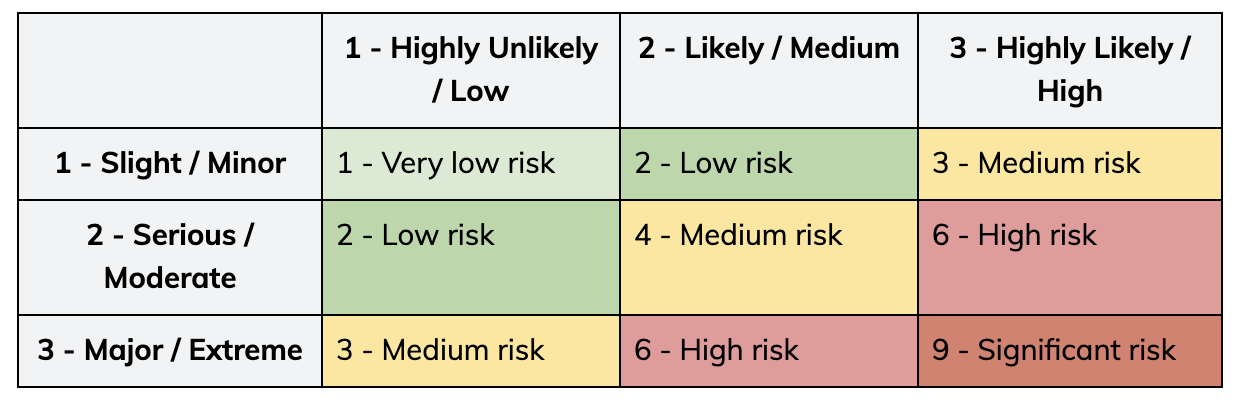
A risk matrix can be valuable in helping you prioritise hazard mitigation. You must eliminate or reduce the risk presented by highly likely hazards with the potential to cause significant harm before addressing the hazards that may have minor consequences and are unlikely to occur.
If you need more variability in risk levels, you might choose to use a 5×5 risk matrix:

- Hazards with a low score (1-3) are deemed acceptable, but that doesn’t mean you should ignore them or allow standards to slip. You should maintain any measures already in place that may be mitigating these risks.
- Moderate hazards (4-6) are considered adequate and not an immediate priority to improve, but you may seek to reduce the risk in a future review or when you have mitigated more severe risks.
- Hazards with a high score (8-12) are tolerable, but you should look to reduce the risk level promptly.
- Catastrophic hazards (scoring 15-25) are considered unacceptable, and you should implement control measures immediately to reduce the risk.
When determining what is a hazard and how much of a risk they pose, risk matrices are not perfect. A hazard that rarely causes serious or catastrophic injury might only be considered a moderate risk based on the 5×5 matrix used above, yet the individual who suffers life-changing harm or the family of a loved one who was fatally injured in a work accident because of poor hazard control would likely consider the scenario far worse than “moderate”.
Still, risk matrices are beneficial for assessing risks and hazards. Using it as a tool to guide where you should focus your efforts and how urgently you should take action, and applying a common-sense approach to risk management — go a long way.
Read More: What Are the Types of Risk Assessments?
Mitigating Risk
Remember, a hazard in itself is not inherently good or bad. A heavy box full of tools or fixtures might be a hazard, but the danger lies in the consequences of moving the box without following health and safety best practices, as a worker may suffer injury.
Likewise, not all hazards can be eliminated because they’re vital to the work. You might list ladders as a hazard because there is a risk an employee could fall, but that doesn’t mean you should remove all ladders from the workplace; otherwise, you wouldn’t be able to fulfil your contractual obligations to a client.
However, you can — and should — reduce the chance of harm. The risk from lifting heavy boxes becomes much less severe when you train workers on manual handling techniques. Similarly, you can mitigate fall injuries from ladders by ensuring your workers use regularly maintained personal protective equipment (PPE) and halting work in dangerous weather conditions when a slip might be more likely.
Finally, once you’ve conducted your risk assessment to identify what is a hazard and what is a risk in your workplace, you must revisit it regularly.
This document is more than a tick-box exercise to comply with legal requirements and demonstrate your commitment to health and safety — it is a roadmap for creating a safer work environment. By reviewing your risk assessment at least once a year — or whenever you introduce a new procedure or make substantial changes — you can monitor progress towards reducing risk, identify new dangers and ensure you aren’t focusing on irrelevant hazards.
Understanding the differences between risks and hazards is essential for maintaining a safe workplace. But documenting the risks affecting you can be challenging.
Smaller businesses might struggle to get to grips with the process if they do not have a formal health and safety culture or the appropriate policies. Larger organisations face unique challenges, too — the sheer volume and scale of potential hazards can prove intimidating and make it hard to prioritise risks effectively.
It can be tempting to adopt the risk assessments of similar businesses in your industry as a framework for your own. However, your risk assessment must be specific to your business, as the hazards in your workplace — and the risks they pose — will be unique.
However, you can use a risk assessment template for guidance — and to save time and frustration.
Read More: Download Your Free Risk Assessment Template
Veriforce CHAS offers a range of electronic risk assessment and method statement templates that can help you effectively identify the hazards and risks affecting your business.
CHAS members can also claim a free one-month trial of CHAS RAMS, an online tool to help you create Risk Assessments and Method Statements, anywhere and anytime. CHAS RAMS covers an extensive library of activities, from small tasks to large-scale projects including working at height and manual handling to plumbing, electrical installation and roof works. Find out more here: CHAS Rams | Powered by HandsHQ – CHAS


