

Most construction workers are aware that, by law, risk assessments must be used to protect the health and safety of both site workers and members of the public.
But what does a risk assessment actually look like? In this article, we’ve put together an example of a risk assessment for a hypothetical construction company that installs temporary fencing. You can use this as a reference point, but please don’t copy the text exactly! You must consider the specific health and safety risks your unique situation poses.
Need to download a FREE risk assessment template? You can use the download link in the form below. Please see our risk assessment template and guide for more information on risk assessments.
Free Risk Assessment Template
Take the stress and confusion out of creating a risk assessment with our free template.
Enter your details, and we’ll email you a risk assessment template that’s both compliant and comprehensive to use.
By submitting this form you confirm you are happy to be contacted by CHAS in accordance with our Privacy Policy
Why Standardisation Matters: The Common Assessment Standard
Construction risk assessments identify and control hazards on a specific site, pinpointing the activities, equipment or conditions that could cause harm and setting out the measures to keep workers safe. By contrast, the Common Assessment Standard (CAS) is a single, unified pre-qualification questionnaire used across the UK construction industry to evaluate a contractor’s overall capabilities and risk management systems. Developed by Build UK in partnership with CECA and other verification bodies, CAS replaces multiple scheme memberships and audits with one consistent framework.
When you align your site-specific risk assessments with CAS criteria, you not only ensure that hazards are managed locally but also demonstrate to buyers and clients that your organisation meets the same high standard of competence and compliance across every project.
When Is A Risk Assessment Needed In Construction?
Before we show you an example of a completed risk assessment for construction, we’ll quickly recap when a risk assessment is needed.
- All construction projects, regardless of size or complexity, require a risk assessment.
- When a new construction site is established, a risk assessment must be completed.
- If there are any substantial changes or modifications to an existing construction site, a risk assessment should be completed.
- When new tools or equipment are added to a construction site, a risk assessment should be carried out. Note that specific pieces of equipment, such as lift trucks, have specific health and safety requirements.
- Certain high-risk activities, like working at height or working with hazardous substances, require specific risk assessments.
- Substantial changes to the workers on site, including subcontractor and contractor changes, might mean that a new risk assessment is needed.
Examples Of A Risk Assessment In Construction
Below, we’ve completed an example risk assessment for installing temporary fencing.
Step 1: Risk Assessment Key Details
It’s important to keep a record of your risk assessment’s key details, including the assessor’s name, the assessment date, and the review date. This allows you to keep your documentation organised and the roles and responsibilities of the key people involved clear.

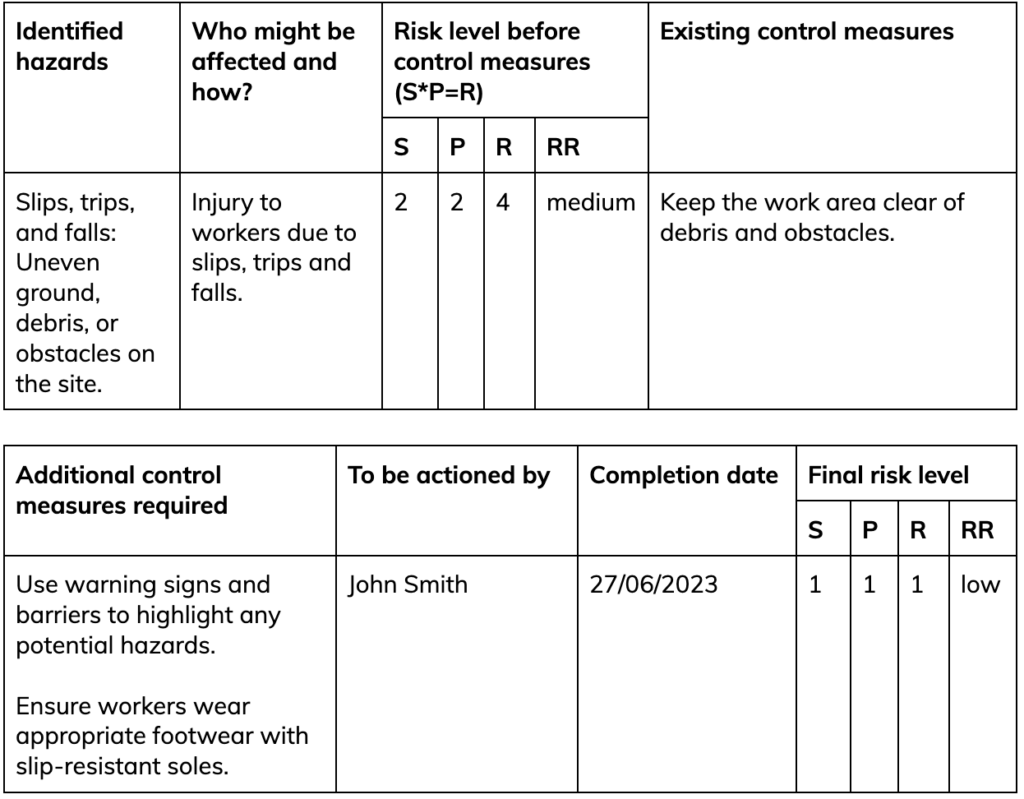
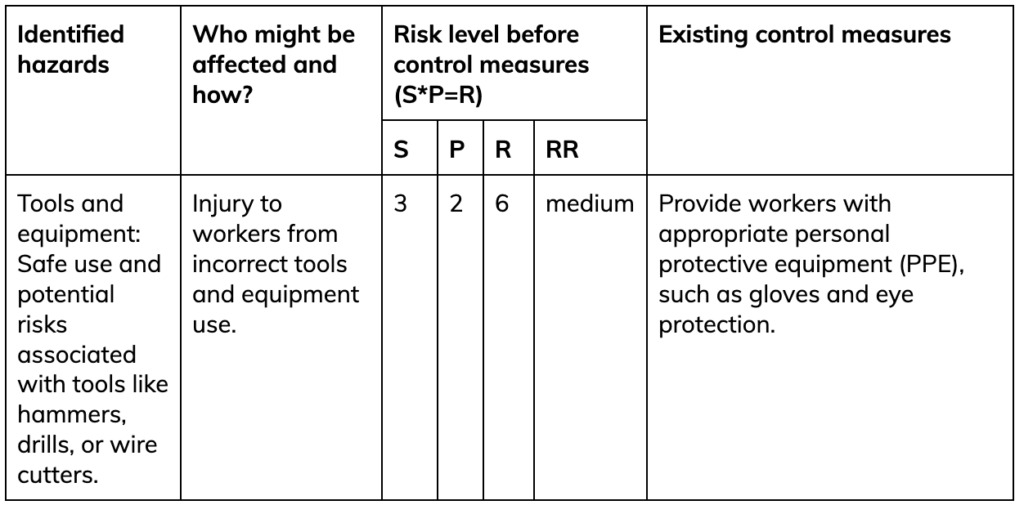
Step 2: Identify Hazards, Risk Levels, And Existing Control Measures
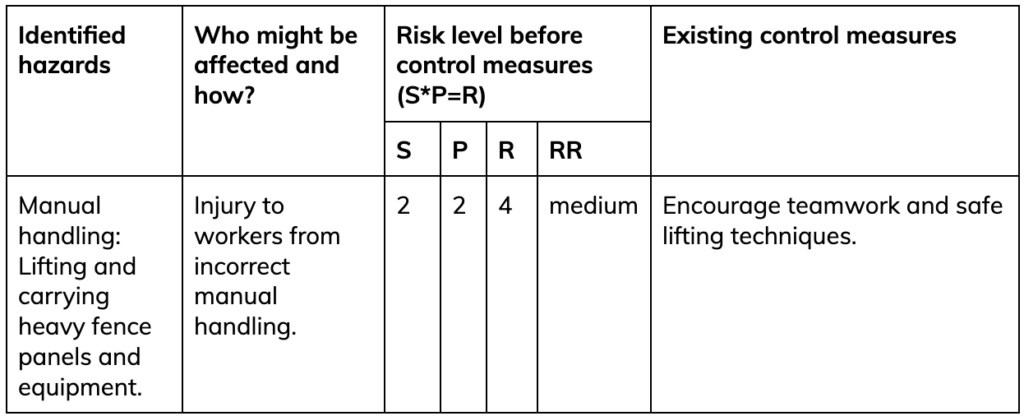
The next part is identifying the possible hazards associated with the specific task and considering who might be affected and how. You should assign a severity (S) rating and probability (P) rating for each hazard.
The ratings should be given out of three, as follows:
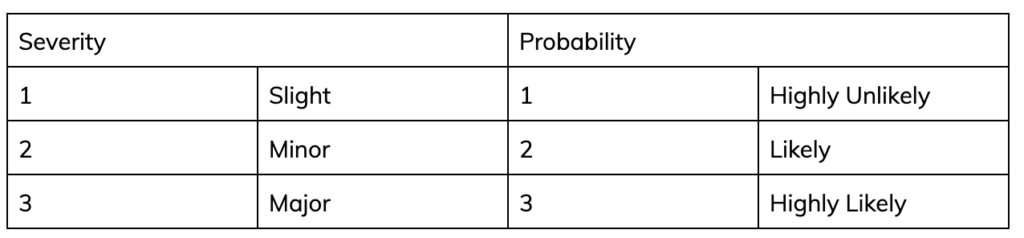
Severity indicates the scale of the risk to the people who might be affected. For example, the risks associated with working at height or heavy machinery are major because there’s the potential for major injury or even death. On the other hand, the risks associated with slips, trips, and falls, or manual handling, might be slight or minor, depending on the circumstances.
When you have an assigned S and P rating, multiply the two numbers to get risk (R). The risk will be represented as a number between 1 and 9. If your answer is between 1 and 3, the risk rating (RR) is low. The risk rating is medium if your answer is between 4 and 6. The risk rating is high if your answer is between 7 and 9. You should take action depending on the risk rating of an activity, as described below.
Risk Rating Actions Required
1-3, Low. Continue to review working practices regularly and implement any additional control measures required within the time scale given in the risk assessment.
4-6, Medium. Implement control measures and review working practices regularly. Review tooling and working practices used to reduce the probability of an accident to the lowest level possible (employee consultation should be included in the review).
7-9, High. Do not allow work to start, and review working practices immediately. Implement all the additional control measures identified in the risk assessment. Continue to review and implement additional control measures until the probability of an accident reduces to the lowest level possible. Employee consultation should be included in the review.
For each identified hazard, you should also describe any existing control measures. These are things that you have in place to reduce the risk associated with an activity. They can be tangible, like protective barriers, and intangible, like training and instructions.
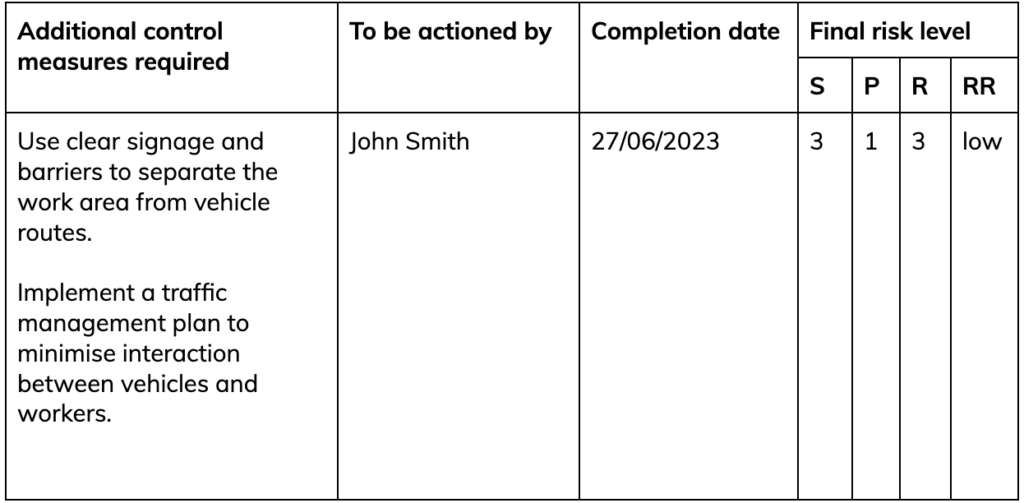
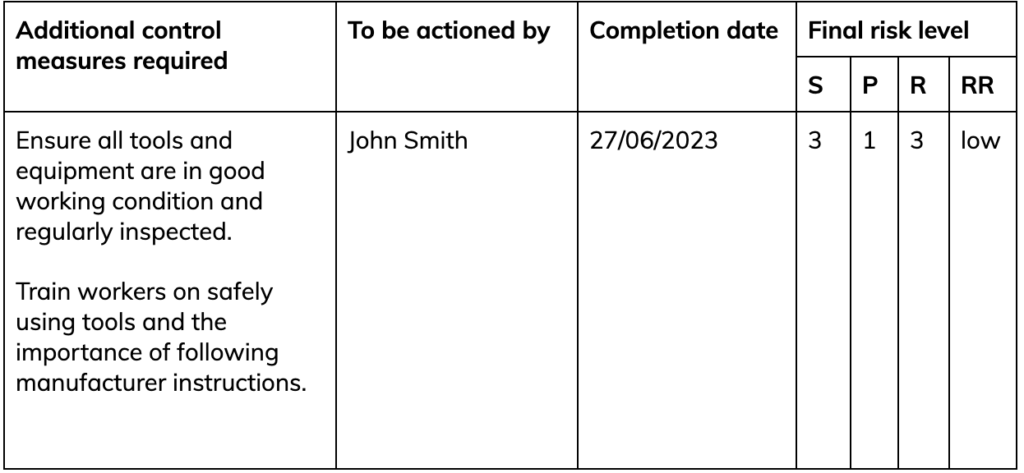
Step 3: Additional Control Measures Required
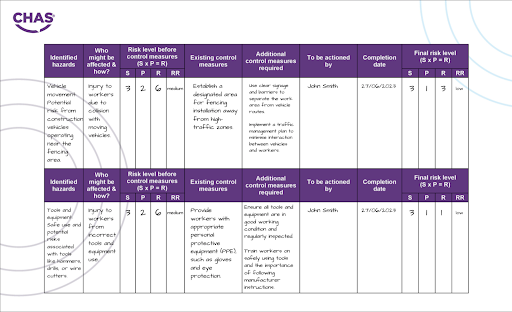
The next step is to add additional control measures as needed to reduce risks to the lowest possible level. You must do this even if an activity’s risk rating is already low. For each additional control measure required, note down who will action the control measure and the completion date. Once you have done this, you can note down the final risk level of the activity, which assumes that additional control measures are in place.


Step 4: Share The Risk Assessment With All Workers
You should share the risk assessment with all workers, as in the example below. Allow each worker to add their comments and review their suggestions. Get a signature from each worker and note the date when the information was shared. You should store your risk assessment in an easily accessible place, so it can be reviewed by workers as needed.
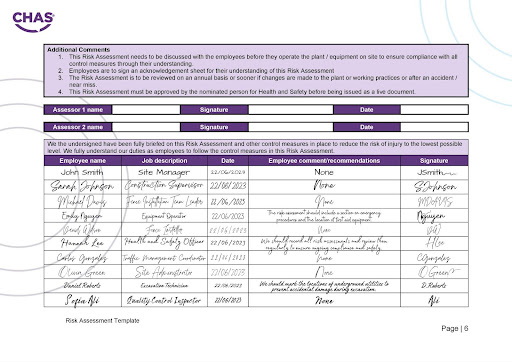
We, the undersigned, have been fully briefed on this risk assessment and other control measures in place to reduce the risk of injury to the lowest possible level. We fully understand our duties as employees to follow the control measures in this risk assessment.
| Employee Name | Job Description | Date | Employee Comments/Recommendations | Signature |
| John Smith | Site Manager | 22/06/2023 | None | John Smith |
| Sarah Johnson | Construction Supervisor | 22/06/2023 | None | Sarah Johnson |
| Michael Davis | Fence Installation Team Leader | 22/06/2023 | None | Michael Davis |
| Emily Nguyen | Equipment Operator | 22/06/2023 | The risk assessment should include a section on emergency procedures and the location of first aid equipment. | Emily Nguyen |
| David Wilson | Fence Installer | 22/06/2023 | None | David Wilson |
| Hannah Lee | Health and Safety Officer | 22/06/2023 | We should record all risk assessments and review them regularly to ensure ongoing compliance and safety. | Hannah Lee |
| Carlos Gonzalez | Traffic Management Coordinator | 22/06/2023 | None | Carlos Gonzalez |
| Olivia Green | Site Administrator | 22/06/2023 | None | Olivia Green |
| Daniel Roberts | Excavation Technician | 22/06/2023 | We should mark the locations of underground utilities to prevent accidental damage during excavation. | Daniel Roberts |
| Sofia Ali | Quality Control Inspector | 22/06/2023 | None | Sofia Ali |
If you need help demonstrating your health and safety compliance, joining CHAS is the best way to do it. We’ve helped over 32,500 businesses with their risk assessments. If you’d like to learn more, speak to a member of our award-winning team at 0345 521 9111.
Free Safety Method Evaluation Statement
Use our free safety method statement evaluation template to ensure your teams are health and safety compliant.
Enter your details and receive your free safety method evaluation statement template in your inbox.
By submitting this form you confirm you are happy to be contacted by CHAS in accordance with our Privacy Policy

