


Here’s a fast fact: Britain’s construction industry saw 61,000 cases of non-fatal work-related injuries in 2021. According to HSE figures, slips and trips were the most common type of construction injury, while the incidence rate of falls from a height surpassed all other industries.
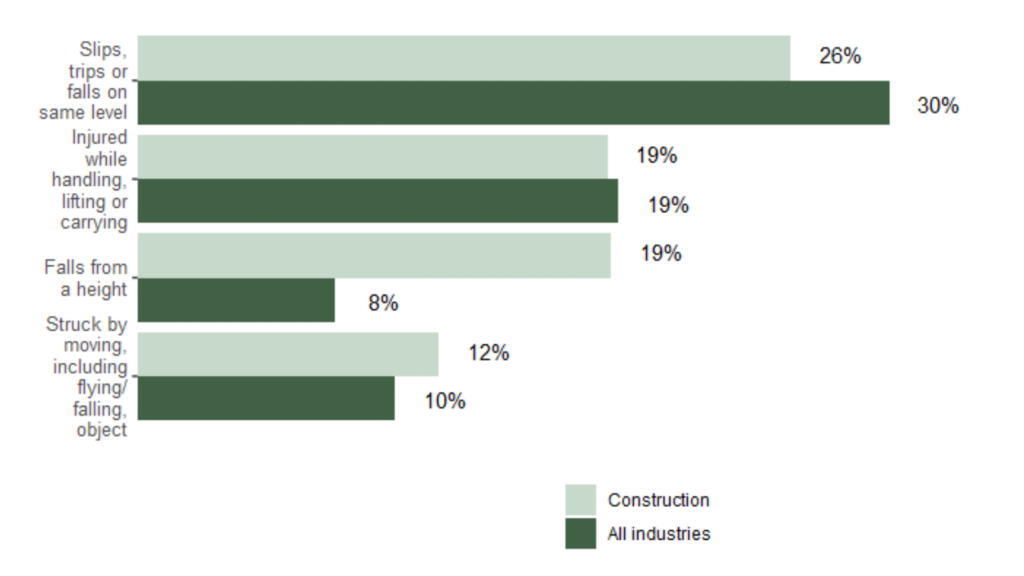
Image by HSE
The dangers of working in construction highlight the importance of investing in workplace health and safety training.
While training, along with sufficient information, instruction and supervision, is a legal obligation under the Health and Safety at Work etc. Act 1974, construction companies that go the extra mile can reap rewards in the form of better employee morale, improvements to your reputation and better relationships with new and existing clients.
Related Reading: Who Is Responsible for Workplace Health and Safety?
What Is Health And Safety In The Workplace?
Workplace health and safety is a set of principles, practices and attitudes that revolve around managing health and safety risks to your workers. A strong health and safety culture is characterised by active leadership that sets the tone for the organisation, all while involving the feedback of managers, workers, contractors and customers.
In the context of the construction industry, health and safety practices in the workplace seek to mitigate hazards on building sites, including (but not limited to):
- Manual handling (i.e. carrying, lifting, pushing and pulling) of objects
- Heights
- Noise
- Vibration
- Skin hazards (e.g. chemicals, hot hazards)
- Biological hazards
- Fire safety
- Asbestos
- Dust
- Paint and coatings.
To gain a full understanding of the health and safety risks in the construction industry, be sure to read the HSE guide Health and safety in construction.
Related Reading: Why Building Site Health and Safety Matters
What Is Workplace Health And Safety Training?
Health and safety training is the process of educating people to be safe at work. It means helping people learn how to perform tasks safely, teaching them best practices to follow and common mistakes to avoid, as well as providing them with sufficient information about tasks and procedures.
In construction, training can range from “formal” classroom-based courses to on-the-job training through shadowing.
Why Do You Need Health And Safety Training?
As mentioned earlier, workplace health and safety training is part of your legal duty of care. But investing in training also offers specific benefits, such as:
- It ensures that the people working on a job site or facility know how to work without compromising their health and safety.
- Training enables you to create and support a positive health and safety culture, where safe practices and awareness of hazards are second nature to everyone in the organisation.
- Effective training helps improve your employees’ health and safety skills — something they can add to their core competencies.
- Training helps you prevent the distress and disruption of accidents and illness.
- Training helps you avoid the financial and legal costs of accidents, poor occupational health and safety and damage to your products and equipment.
Related Reading: What Is Safety Culture? Your Guide To Positive Safety Culture
How To Offer Health And Safety Training In Construction

Although every construction business will have a different approach to health and safety training, some steps apply to just about any organisation. For example, HSE recommends the following five-step approach:
1. Identify The Type Of Health And Safety Training You Need
Health and safety training is a broad subject, especially in construction, which has a wide range of workplace hazards. To get started, HSE recommends:
- Identifying the skills and knowledge your employees need to work safely
- Comparing these skills with your employees’ current skill level and knowledge
- Reviewing your history of workplace injuries, work-related illness and close shaves
- Considering training for everyone, from executives down to subcontractors.
2. Plan Your Training Priorities
Next, compare your company’s top priorities with your training objectives and see how they align. For example, the law or approved code of practice may require you to conduct specific training. In construction, one example is asbestos awareness training.
Other priorities to consider include:
- Urgency — does the lack of training in one aspect of work have a high risk of leading to serious harm?
- Largest benefits to the largest number of staff
- Recruits
- Employees switching to new roles
- New legislation (e.g. Building Safety Bill) or industry guidance.
3. Choose Your Training Methods And Resources
Health and safety training methods include:
- Classroom-based learning
- Providing information and instruction through reading material and handbooks
- Coaching and/or on-the-job training
- Open or distance learning
- Individual learning>
- Computer-based learning.
You should also consider who can help you train your workforce. Organisations such as the Institution of Occupational Safety and Health (IOSH), the Construction Industry Training Board (CITB) and the British Safety Council offer health and safety courses specifically designed for the construction industry.
4. Provide The Training
This step should be simple enough if you’re working with a third-party training provider like the CITB. At this step, your role is to provide time for your workers to undergo training and make sure the trainer/training body has an appropriate place or channels to hold lectures and share information.
5. Assess The Impact Of Training
After carrying out training, it’s important to assess what your employees have learned. You can ask the following questions:
- Do they now have the skills and knowledge to work without risking their health and safety?
- Are they using the processes and practices for doing work safely?
- Have there been any improvements in your business’s health and safety performance?
- Did they respond well to the training method/s used?
- Is further training needed?
You can find more information about how to deliver health and safety training in your organisation by reading HSE’s Health and Safety Training Guide.
Over To You — Train Well And Train Often
Finally, it’s important to remember that health and safety training must be an ongoing effort. Memories fade, bad habits creep in and people get sloppy — consistent training reduces the risk of human error leading to accidents and illness.
Be sure to follow the CHAS blog to get more insights on health and safety in the construction industry. You can also take the first step to improve health and safety standards in your organisation by joining CHAS and achieving the Common Assessment Standard. As a CHAS member, you will gain access to risk management tools, materials and nationally-recognised accreditation programmes to mitigate risks in up to 13 areas of risk management — health and safety included.
Got A Small Works Job? Get A Free Health & Safety Guide
Are you wondering whether you should adjust your health and safety procedures for your small works project?
Enter your details to download our free guide on how to notify HSE and complete a health and safety file for small works jobs.
By submitting this form you confirm you are happy to be contacted by CHAS in accordance with our Privacy Policy

