


Researchers from the University of Nottingham’s Rights Lab, in collaboration with CHAS, the UK’s leading provider of risk prevention, compliance and supply chain management services for contractors and clients, are conducting a study on knowledge and awareness about addressing modern slavery amongst SMEs (small and medium-sized enterprises).
The research has two objectives:
- First, it seeks to understand the awareness and knowledge SMEs in the UK have about modern slavery. Rights Lab researchers are gathering insights on how business leaders address the risk that unlawful labour practices pose to their business, supply chain and communities.
- Second, the project aims to use the study’s findings to develop resources to help CHAS members take concrete steps to address modern slavery. Many of these members are in the construction sector, which is second only to the sex industry in the EU for being the most prone to labour exploitation.
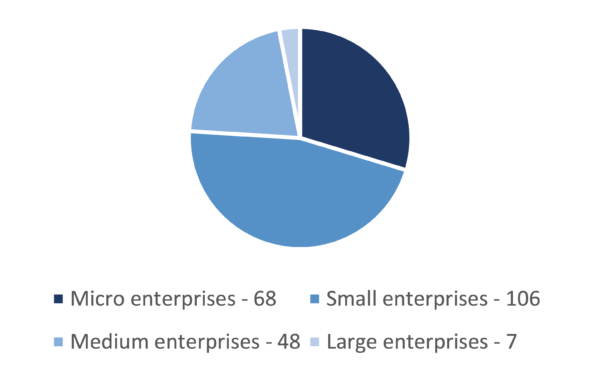
We recently commissioned a preliminary survey to gain insight into CHAS members’ awareness, attitudes and behaviours in relation to modern slavery policies. Researchers surveyed 229 businesses — of which 222 are SMEs and 169 are companies operating in the construction sector.
Free Risk Assessment Template
Take the stress and confusion out of creating a risk assessment with our free template.
Enter your details, and we’ll email you a risk assessment template that’s both compliant and comprehensive to use.
By submitting this form you confirm you are happy to be contacted by CHAS in accordance with our Privacy Policy
Modern Slavery in SMEs — What’s the Significance?
With SMEs representing 99.9% of the UK’s total business population (6 million) and generating a combined turnover of £2 trillion in 2020, these businesses are in a unique position to take anti-slavery action. However, much of the conversation on modern slavery focuses on larger organisations.
For example, Section 54 of the Modern Slavery Act 2015 (MSA) only requires companies with an annual turnover of £36 million or more to produce a modern slavery statement — part of which will include a modern slavery risk assessment. Organisations that fall below this threshold, the majority of which are SMEs, can report voluntarily.
It’s no surprise then that the findings of this preliminary survey show that while many respondents believe their organisation is committed to tackling modern slavery and implementing policies to prevent labour exploitation, many fall short of taking further actions. You can download the full report of the study’s preliminary findings, written by Dr Akilah Jardine.
Modern Slavery in SMEs — 5 Key Findings
Here are some of the preliminary study’s key highlights.
1. The Majority of Respondents Are Committed to Addressing Modern Slavery
Addressing modern slavery in the workplace requires the entire organisation to commit to mitigating the risk of labour exploitation. Our survey found that 67% of respondents stated that their organisation is committed to tackling this issue.
2. Nearly Three in Five SMEs Have Implemented Anti-slavery Policies for over Six Months
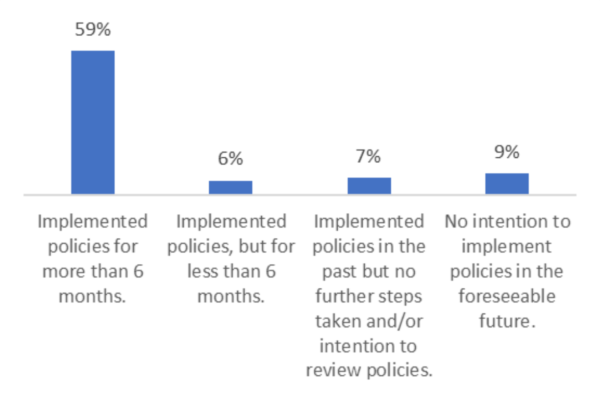
We found that nearly 60% of organisations have implemented a modern slavery policy for over six months. In contrast, 9% said they had no intention of implementing such a policy in the foreseeable future.
A modern slavery policy is a document or statement that demonstrates a company’s commitment to addressing the risk of modern slavery and taking the appropriate action to mitigate it throughout the organisation.
3. 40% Of Companies Do Their Modern Slavery Due Diligence
Modern slavery due diligence is the continual process of identifying and mitigating modern slavery risks within a company and its supply chains. Our survey shows that 39% of companies said they had conducted due diligence activities related to modern slavery for over six months. However, 17% of organisations had no plans to carry out due diligence in the near future.
4. Half of Companies Have No Plans to Monitor KPIs for Modern Slavery
Key performance indicators (KPIs) for modern slavery are measurable values that demonstrate the effectiveness of an organisation’s anti-slavery efforts.
Examples of modern slavery KPIs include:
- Number of audits conducted
- Number of modern slavery training sessions given
- Number of suppliers/contractors (of materials, labour and services) engaged.
We found that half of the companies we surveyed had no intention to measure KPIs related to modern slavery in the foreseeable future.
5. Stakeholders Need to Put More Pressure on SMEs
Finally, our survey findings show that the majority of SMEs look to the government, other larger businesses and key stakeholders for guidance on addressing the problem of modern slavery.
- We found that 66% of organisations do not feel pressured by the government and larger enterprises to check their risk for modern slavery.
- Meanwhile, 67% said they do not feel pressure from consumers and other civil society stakeholders to address modern slavery.
Are You Ready To Be A CHAS Client?
Sign up for FREE today or learn more about our client services by scheduling a callback with one of our friendly CHAS advisors.
Request A Callback
Implications and Anti-slavery Actions to Follow
Our findings show that Government policies to prevent labour exploitation are insufficient to address the issue of modern slavery in SMEs.
The assumption is that larger companies, which are legally required to submit modern slavery statements by the MSA, will cascade this responsibility down their supply chain to contractors and suppliers. But our preliminary survey indicates that these and other drivers of anti-slavery action don’t put enough pressure on SMEs to create modern slavery policies.
CHAS is currently commissioning interviews with SME leaders in construction to gather insights on modern slavery in the construction industry, including anti-slavery priorities and barriers to take action against exploitation.
Download the full report to get a full explanation of our study’s overview and by clicking the link below.
At CHAS, we offer a range of supply chain risk management services designed to help your organisation address risks such as modern slavery. As a client, you can sign up free of charge and keep track of your supply chain partners’ compliance with modern slavery legislation.
Anti-slavery resources are also available to CHAS contractors. Sign up today to access industry-leading accreditation schemes and risk management resources, including training modules, risk assessment templates, business shield support and more.
Written in Collaboration with the Rights Lab at the University of Nottingham
The Rights Lab at the University of Nottingham is home to the world’s largest group of modern slavery researchers and experts. As one of the university’s six Beacons of Excellence, the Rights Lab sits at the forefront of efforts to address modern slavery. The programme is powered by five research programmes that constantly deliver new research:
- Data and Measurement Programme
- Communities and Society Programme
- Ecosystems and the Environment Programme
- Law and Policy Programme
- Business and Economies Programme
Together, these programmes deliver evidence-based strategies to meet the ambitious goal of ending global slavery by 2030.
Free Anti-Modern Day Slavery & People Trafficking Policy Template
Are you wondering how to create a modern-day slavery and people trafficking policy?
Our free guide tells you everything you need to know to ensure your organisation and supply chain is careful not to employ vulnerable, trafficked workers.
Enter your details, and we’ll email you a free guide and template
By submitting this form you confirm you are happy to be contacted by CHAS in accordance with our Privacy Policy

