


In recognition of International Women’s Day (IWD), Niche Sullivan, Construction Sector Lead at Veriforce CHAS, takes a closer look into the growing issue of PPE for women and why PPE that fits is crucial for health and safety, equality, and growth in the construction industry.
Personal protective equipment (PPE) is vital in mitigating the health and safety risks in construction sites. The provision of adequate PPE to all workers in job sites is also required by law under the Personal Protective Equipment Regulations 1992, which, from 6 April 2022, includes head protection (e.g., hard hats).
Yet, be that as it may, the construction industry has long overlooked the necessity of providing PPE for women — particularly PPE that fits them properly. The prevailing one-size-fits-all approach to PPE has failed to consider the clear anatomical differences between men and women, placing female workers in a state of potential risk and discomfort when working on construction sites.
Related Reading: Updated PPE Regulations: What You Need To Know
Enter The #PPEthatfits Movement
The issue has prompted the Chartered Institute of Building (CIOB) to launch the #PPEthatfits initiative, tackling the unequal distribution of suitable PPE within the construction sector.
Developed in collaboration with the Construction Management and CIOB People, the #PPEthatfits initiative seeks to raise awareness about the current shortage of suitable PPE in the industry and examine its effects on health and safety at construction sites, as well as its impact on the sector’s capability to attract and maintain a diverse group of workers. Additionally, the campaign includes a regularly updated list of vendors offering appropriate #PPEthatfits.
In recognition of International Women’s Day (IWD), we take a closer look into the need for tailored PPE for women and why it’s crucial for health and safety, equality, and growth in the construction industry.
Related Reading: Women in Construction: Challenging Gender Inequality
The Current State Of PPE For Women In Construction
The Health and Safety Executive’s (HSE) guidance on the provision of PPE to workers states that “PPE provided must be compatible, maintained and correctly stored.”
One could argue that “compatible” would include factors like fit and comfort, but this is sadly often not the case in the construction sector. Katy Robinson, a Senior Project Manager at East Riding of Yorkshire Council, is all too familiar with the problem.
“…(the women’s safety boots) also had sufficient ankle support, insoles designed for women’s feet, and were actually comfortable.”
Writing for the Construction Industry Council, Katy said it wasn’t until 2023 — after six years in the construction industry — that she finally received her first pair of safety boots specifically designed for women.
“After years of assuming ‘all safety boots must be uncomfortable,’ I was pleasantly surprised to receive a pair of women’s safety boots,” she said. “Not only did I only have to wear a single pair of walking socks — instead of the usual two or three pairs — but they also had sufficient ankle support, insoles designed for women’s feet, and were actually comfortable.”
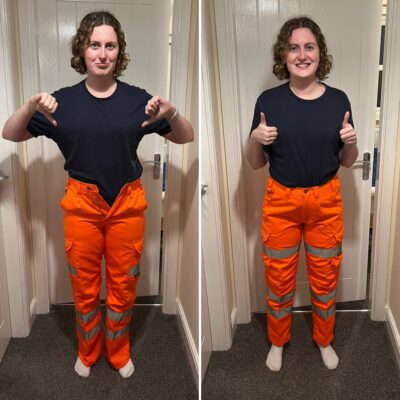
Katy Robinson shows the difference between men’s and women’s high-visibility trousers
Source: SHP (Safety & Health Practitioner)
As the Campaign Manager of the National Association of Women in Construction for Yorkshire (NAWIC Yorkshire), Katy would later go on to spearhead the NAWIC Yorkshire Women’s PPE campaign — a decision also influenced by the CIOB’s #PPEthatfits initiative. The campaign seeks to increase awareness about the widespread inequalities in PPE provision in construction.
The campaign’s launch was marked by the publication of the Women’s PPE in the Construction Industry report, which shows that 59.6% of women have no choice but to wear PPE that is designed for men.
Katy and NAWIC Yorkshire are not alone in the push for more inclusive PPE. Bold as Brass, a support network for women in construction, mining, energy, highways, rail, engineering and environmental services, is also tackling the lack of accessible PPE for women.
Writing for Ground Engineering, Bold as Brass founder Katherine Evans highlighted the issue of high-visibility PPE for women.
“…The trousers are tight on the hips and thighs, baggy and too long in the legs, as well as loose around the waist.”
“The female body is not the same as that of men; neither are its processes,” she explained. “We need our kit to be designed with breast capacity, narrow shoulders, shorter arm and leg lengths, and cuts that account for wide variations in pelvis and waist ratios.”
Katherine also echoed the issue highlighted in NAWIC Yorkshire’s report.
“Right now, many of our members are wearing men’s PPE. The trousers are tight on the hips and thighs, baggy and too long in the legs, as well as loose around the waist,” she said.
The Importance Of Women’s PPE And Safety Items
The provision and use of women-specific PPE go a long way towards ensuring women’s safety in the construction industry. There are two elements to this need: physical safety and psychological safety.
Physical Safety
Ill-fitting PPE presents obvious safety hazards, such as an increased risk of tripping or exposure to harmful substances (think dust and vapours) due to gaps in protection.
“Coats are dangerously long in the arms and don’t always have a cuff fastener, so they hang loose over the hands,” Katherine explained. “To comply with EN ISO 20471, vests are like little orange tents on a petite to average-sized woman.”
Boots that are too large or trousers that are too long could very well lead to a trip or fall from a height — the leading cause of death in the construction industry.
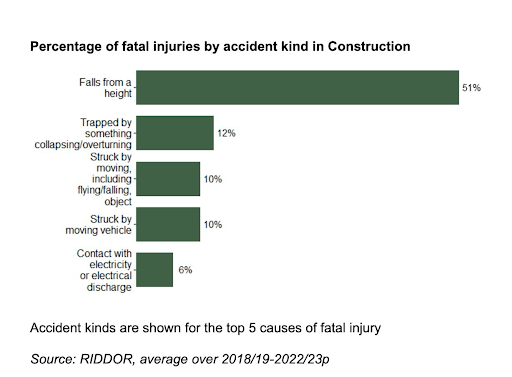
Source: HSE
Psychological Safety
Poor-fitting PPE also contributes to a sense of exclusion and diminished professionalism. This is particularly relevant in industries traditionally dominated by men.
Insights from NAWIC Yorkshire’s report highlight a complex scenario. Many of the respondents expressed feelings of appearing unprofessional due to oversized clothing, feeling marginalised, and being perceived as less knowledgeable or experienced. The psychological toll of not fitting into the expected professional mould can undermine confidence and deter women from pursuing long-term careers in such environments.
Barriers To Making PPE For Women More Accessible
Overcoming the barriers to making PPE for women more accessible involves navigating a complex landscape of economic, logistical, regulatory, and societal challenges.
1. Logistics And History
For starters, manufacturers and construction companies often face economic pressures and logistical complexities in producing and distributing PPE tailored for women. This is compounded by regulatory standards that historically have not prioritised the distinct needs of women in PPE design. While disappointing, this is not surprising; ONS data shows that women comprise just 15% of the construction workforce.
2. Cultural Attitudes
Cultural and societal attitudes towards women in the construction industry further exacerbate the issue of inaccessible PPE for women.
Katherine notes that there’s a prevailing belief among some brands and suppliers that there is a minimal market for women’s PPE, and procurement departments often dismiss the need for gender-specific gear with comments like, “it’s not a fashion show, just wear the men’s.”
3. Small Business Constraints
In a separate column for SHP (Safety & Health Practitioner), Katy explained that one of the key challenges facing NAWIC Yorkshire is influencing SMEs, which represent 60% of employment in the construction sector but are less likely to have the resources to provide for
women’s PPE needs compared to larger organisations.
To mitigate this challenge, NAWIC Yorkshire has lobbied providers of health and safety accreditations to include provisions for women’s PPE. To Katy’s surprise, several accreditation bodies agreed to incorporate women’s PPE into their assessment criteria, with implementations starting in 2024.
Make Steps Towards Change With Veriforce CHAS
While the provision of PPE for women is still gaining momentum, everyone in construction will likely agree that PPE should be comfortable. Work in the construction industry is difficult and demanding enough as it is. Everyone, regardless of gender, should at least feel comfortable while on the job.
Veriforce CHAS is committed to leading the charge towards meaningful change, advocating for the development and widespread adoption of gender-specific PPE solutions. By signing up and becoming a CHAS Client, we can help your organisation by guiding your contractors through the necessary steps to make their workforces more inclusive.

