


In the construction industry, risks are abundant, so having rigorous health and safety standards in place is vital. One critical component of this is understanding and complying with RIDDOR.
This guide delves into what RIDDOR stands for, its importance in health and safety and how construction professionals can effectively report incidents.
What Does RIDDOR Stand For?
RIDDOR stands for the Reporting of Injuries, Diseases and Dangerous Occurrences Regulations. Established in 2013, these regulations mandate the reporting of specific work-related incidents to the Health and Safety Executive (HSE) or relevant local authorities.
In 2023/24 alone, 61,663 employee non-fatal injuries were reported by employers under RIDDOR, highlighting just how crucial this system is for identifying workplace risks and driving continuous safety improvement.
The primary goal is to ensure that serious workplace accidents, occupational diseases and dangerous occurrences are formally recorded and investigated to prevent future incidents.
Why Does RIDDOR Matter In Health And Safety?
Compliance with RIDDOR is not just a legal obligation; it’s also vital for proactive health and safety management. Accurate reporting under RIDDOR can improve:
- Workplace Safety: By identifying incident patterns, organisations can implement measures to mitigate risks.
- Legal Compliance: Non-compliance can lead to legal repercussions, including fines and sanctions.
- Transparency: Demonstrates a commitment to employee welfare and improves trust among stakeholders.
Related Reading: Why Manage Health And Safety At Work?
What Incidents Must Be Reported Under RIDDOR?
There are several incidents that must be reported under RIDDOR; these include:
1. Work-Related Fatalities
Any death resulting from a work-related accident must be reported, excluding suicides.
2. Specified Injuries To Workers
These encompass:
- Fractures (excluding fingers, thumbs and toes)
- Amputations
- Loss of sight (both temporary and permanent)
- Serious burns
- Unconsciousness caused by head injury or asphyxia
- Any injury leading to hypothermia, heat-induced illness, or requiring resuscitation/hospitalisation for over 24 hours.
3. Occupational Diseases
When a doctor diagnoses an employee with a work-related disease, such as:
- Carpal tunnel syndrome
- Severe cramping of the hand or forearm
- Occupational dermatitis
- Hand-arm vibration syndrome
- Occupational asthma
- Tendonitis or tenosynovitis
4. Dangerous Occurrences
These are near-miss events that could have led to significant harm, such as:
- Collapse or failure of lifting equipment
- Explosions or fires causing work stoppage
- Accidental release of hazardous substances
5. Injuries To Non-Workers
If a member of the public is injured due to a work-related activity and is taken directly to the hospital for treatment, it must be reported.
Related Reading: What Are Employees’ Health and Safety Duties?
Free Risk Assessment Template
Take the stress and confusion out of creating a risk assessment with our free template.
Enter your details, and we’ll email you a risk assessment template that’s both compliant and comprehensive to use.
By submitting this form you confirm you are happy to be contacted by CHAS in accordance with our Privacy Policy
How To Report A RIDDOR Incident
Timely and accurate reporting is crucial. Here’s how to report under RIDDOR:
1. Identify The Responsible Person
Under RIDDOR, only a ‘responsible person’ is permitted to submit a report. The responsible person is the individual or entity in control of a work premises where a reportable incident occurs. This can include employers, some self-employed people, or those in charge of the premises. It is this person’s legal duty to report certain work-related incidents, diseases, and dangerous occurrences.
2. Determine The Reportable Incident
Assess whether the incident falls under the categories specified by RIDDOR.
3. Report The Incident
Use the HSE’s online reporting system to submit the appropriate form:
For fatalities or major incidents, you can also report by telephone:
- Telephone: 0345 300 9923 (Monday to Friday, 8:30 am to 5 pm)
4. Maintain Records
Keep a record of:
- The date and method of reporting
- The date, time and place of the event
- Personal details of those involved
- A brief description of the nature of the event or disease.
Records should be retained for at least three years.
Most Common Incidents Reported Under RIDDOR
According to the latest HSE data from 2023/24, the most frequent causes of non-fatal injuries reported by employers under RIDDOR were:
- Slips, trips and falls on the same level (31%)
- Handling, lifting or carrying: 17%
- Struck by a moving object: 10%
- Acts of violence: 9%
- Falls from height: 8%.
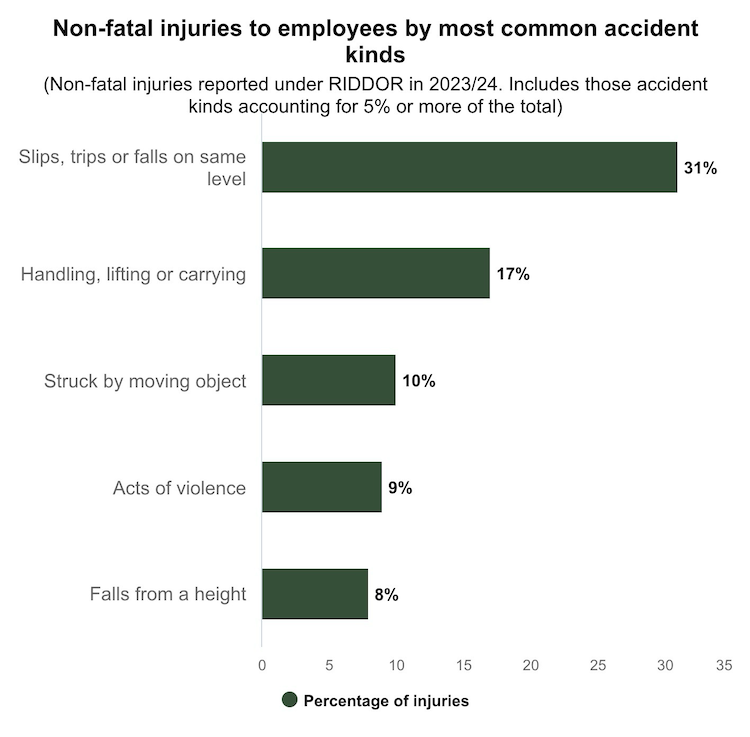
Source: HSE
These figures reflect the various challenges across sectors, particularly in construction, where uneven surfaces, manual handling and working at height are common daily risks.
RIDDOR And Construction
Construction is one of the most regulated sectors under RIDDOR due to its high-risk nature. Common reportable events on construction sites include:
- Falls from height
- Scaffold collapses
- Contact with electricity
- Injuries from tools or moving plant
- Exposure to hazardous materials like asbestos
To reduce these incidents, employers must ensure adequate training, proper PPE, site housekeeping and risk assessments are in place and regularly reviewed.
Related Reading: Workplace Accidents Vs Incidents: What Are The Differences?
Challenges In RIDDOR Reporting
Despite the importance of RIDDOR, many incidents go unreported. A Health and Safety Executive study investigating reporting levels using the Merseyside Accident Information Model found:
- Only 30% of reportable injuries were actually reported.
- Self-employed workers and the hospitality sector had the lowest reporting levels.
- Local and central government had the highest compliance.
- Accidents were most commonly reported when they resulted in lost time over three days.
- Major injuries involving less than three days’ absence were often not reported.
These findings demonstrate a critical gap in health and safety reporting, particularly in sectors like construction where freelance or subcontracted labour is commonplace. Increasing awareness and accountability is key to improving compliance.
Common Misunderstandings About RIDDOR
Some frequent misconceptions include:
- “Only serious injuries need to be reported”: In fact, some seemingly minor injuries (like fractures or occupational diseases) are reportable.
- “Near misses aren’t important”: Dangerous occurrences must be reported even if no injury occurred.
- “If someone doesn’t take time off work, it’s not reportable”: This isn’t true; time off is a factor in some cases, but not all.
RIDDOR focuses on the nature of the incident, not just the outcome.
Related Reading: Health And Safety 101: Explaining The Differences Between Risks And Hazards
With over 61,000 non-fatal injuries reported in a single year, RIDDOR is critical in understanding workplace risks and driving down incident rates. Accurate, timely reporting is a legal obligation, but it’s also vital for responsible safety management.
At Veriforce CHAS, we help businesses across the construction industry meet RIDDOR requirements and improve overall safety. Whether you’re managing subcontractors, self-employed trades, or large teams across multiple sites, knowing when and how to report a RIDDOR incident is essential for compliance, performance and worker wellbeing.
Need Support With RIDDOR Reporting Or Health And Safety Compliance?
Get in touch with Veriforce CHAS today to streamline your health and safety management systems and strengthen compliance across your supply chain.
Free COSHH Risk Assessment Template
Do you or your team handle hazardous chemicals at work?
A COSHH Risk Assessment helps to create a safe working environment. Enter your details for a free template in your inbox.
By submitting this form you confirm you are happy to be contacted by CHAS in accordance with our Privacy Policy

