
LinkedIn
arrow left

Resources

BLOG

How to Improve Equality and Diversity in the Workplace

LinkedIn
image showing workforce diversity

Despite growing awareness of the importance of equality and diversity in the workplace,  discrimination continues to be a major problem for businesses across the UK.

According to the Workforce View 2020 Global report by global HR and payroll firm ADP, over 25% of workers in the UK experienced some form of discrimination in 2020. Of that number, 8% said they experienced age discrimination. Worse, over two-thirds said they would think twice about filing a claim if they were discriminated against.

What Is Workplace Discrimination?

Discrimination in the workplace happens when an employee is treated unfavourably based on their race, gender, age, sexuality and religion, or other personal or protected characteristics. Overt examples of discrimination include bullying employees because of their gender or ostracising certain groups of workers who share certain physical attributes.

However, workplace discrimination also happens indirectly.

For instance, imagine a company where its managers tend to promote only men to management roles despite having fewer credentials or less experience than the women in the team. These actions aren’t necessarily insidious — very often, discrimination occurs because of unconscious biases.  To find out more about unconscious bias, you can take this online test from Harvard University.

Other manifestations of workplace discrimination identified by the UK Government include:

  • Dismissal
  • Employment conditions and terms
  • Salary and benefits
  • Promotion and career opportunities
  • Hiring/recruitment
  • Training

Fortunately, the law is clear that discrimination based on protected characteristics, whether in the workplace or wider society, is illegal. According to the Equality Act 2010, these characteristics are:

  • Age
  • Disability
  • Gender reassignment
  • Marriage and civil partnership
  • Pregnancy and maternity
  • Race
  • Religion or belief
  • Sex
  • Sexual orientation.

Despite these legal protections, however, no law requires employers to have a diverse workforce. It’s a big reason why many working environments continue to be dominated by employees of a particular ethnicity, age or gender.

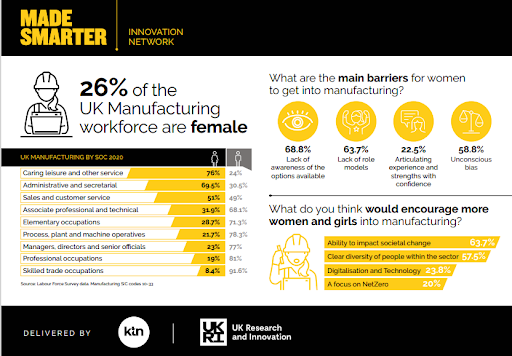
For example, according to a 2019 Building diversity survey, only 4% of workers in the construction industry are Black, Asian and minority ethnic (BAME). Women in construction are also a minority, accounting for only 16% of the workforce, according to the Women and the Economy report. The situation is much the same in manufacturing, with women making up only 26% of the UK manufacturing workforce.

workplace diversity - some statistics
Source: KTN and The Manufacturer

This lack of diversity doesn’t just create a poor experience for employees, but it could also hamper your organisation’s growth. In industries like construction, where the workforce tends to skew white, middle-aged and male, management practices that embrace workplace equality and diversity can be the key to building a competitive edge.

Why Your Company Should Actively Promote Equality and Diversity in the Workplace

A “diverse and inclusive workplace” sounds like a lot of jargon, but it essentially means having a workforce that reflects the same diversity we see in greater society. That means having employees representing different backgrounds, genders, ages, races, beliefs, socioeconomic statuses and abilities.

As attitudes on workplace inclusion change, companies ahead of the curve are reaping the key benefits of their equality and diversity policies.

  • Better Reputation: According to a 2017 PwC report, an inclusive working environment affects how an organisation is perceived by its key stakeholders, including customers, suppliers and employees. A 2020 Manifest survey shows that 70% of job seekers want to work for employers that demonstrate a commitment to diversity and equality. In other words, your company’s ability to attract the best talent also rests on your diversity policies.
  • Higher Employee Satisfaction: Deloitte notes that a company’s diversity practices directly impacted its employees’ engagement. However, employees only feel true satisfaction when diversity and equality go beyond ideology or values — organisations must have actual “policies and practices that make up an organisation’s diversity practices.”

In other words, organisations can’t pay lip service to equality and diversity in the workplace. They need to take credible actions to nurture a diverse workforce.

  • Innovation and Profitability: Equality and diversity also have a tangible effect on your bottom line. Research by Deloitte shows that organisations with inclusive and diverse cultures are six times more innovative and agile than companies. They’re also two times and eight times more likely to beat their financial targets and achieve better business outcomes, respectively.

There are several reasons why diversity is linked to better workplace performance. For one, diverse teams are better positioned to understand different customers. For example, if one member shares a cultural background with a client, they’re more likely to build rapport.

Diversity in employees also means diversity in perspective, leading to richer brainstorming sessions and well-rounded ideas.

Are You Ready To Be A CHAS Client?

Sign up for FREE today or learn more about our client services by scheduling a callback with one of our friendly CHAS advisors. 

3 Ways to Promote Equality and Diversity in the Workplace

Although there is no one-size-fits-all approach to promoting equality and diversity in the workplace, what’s true is that many employees are sceptical of organisations that claim to provide equal opportunities.

These beliefs are particularly pronounced among millennials and Gen Z workers, with two-thirds of respondents from both cohorts believing that leaders only pay lip service to diversity and inclusion. They do, however, believe that formal legislation and policies are the keys to actively encouraging workplace diversity.

This represents an opportunity for your organisation. By creating a diversity and equal opportunities policy, you can embed best practices into your hiring and management protocols that drive real and measurable results. Here’s what your policy should include:

1. Diversity and Inclusion Training

Training is a key component of diversity management in the workplace. When done right, training raises awareness and nurtures a better understanding of the impact of discriminatory behaviour.

Diversity and inclusion training also informs employees and managers about the steps they can take when they see or experience unfair treatment stemming from protected characteristics. It can also be used to instil a “No Bystander” policy, encouraging workers to intervene if they see someone use discriminatory language in the workplace.

It’s also a good idea to include diversity and inclusion training in your onboarding process to ensure that new hires get up to speed with your company’s culture and values. You can then follow up with additional diversity courses that dive into specific areas of equality, such as LGBT rights, gender sensitivity, ageism and anti-discrimination law.

2. Assess Your Hiring Practices

Preventing indirect discrimination begins before you even hire someone. Look at your job postings, for example. The law explicitly forbids job adverts from stating or implying that you prefer candidates based on their protected characteristics. Other practices that you may not have considered to be discriminatory include:

  • Using phrases like “highly experienced” or “recent graduate”: Unless they’re actual requirements, these phrases can discriminate against older people who have not had the chance to get qualifications.
  • Having preferences on where to post job adverts: For example, advertising in men’s magazines.
  • Unstructured interviews: Freewheeling interviews can result in candidates being evaluated differently, allowing biases to creep in.

During the interview process, hiring managers cannot ask candidates about their protected characteristics unless you’re doing so for “positive action” to improve equality in your workplace.

3. Identify Metrics for Diversity and Inclusion

No matter how progressive your organisation is, it will still have unconscious and automatic biases. One way to overcome these tendencies is to look at your employee data.

Metrics that measure representation, retention, salary, recruitment, selection and promotion can reveal key trends that show a preference for certain people with shared attributes. For example, tracking your history of promotions may show your organisation is awarding opportunities to people of a specific ethnicity or gender. Your recruitment data may also reveal that your HR department is unknowingly ignoring a wider talent pool.

Again, these biases don’t have to be malicious. Your data will provide an objective overview of your diversity management practices and show whether you’re moving toward your goals for promoting equality in the workplace.

For guidance on improving workplace diversity in your business, become a CHAS client today. We can provide you with insights into where your business may be vulnerable and how you can start to reap the rewards of equality and diversity.

CHAS client membership is 100% FREE and gives you access to our prequalified contractors database, each backed by accreditation schemes such as PAS91 (CHAS Advanced) and the Common Assessment Standard (CHAS Elite).

Want to find out more about becoming a CHAS Client?

Find out how to reduce risk in your supply chain and monitor, report on, and improve compliance with CHAS.

Our brochure provides you with an overview of CHAS client services and guidance on how to become a client.

By submitting this form you confirm you are happy to be contacted by CHAS in accordance with our Privacy Policy

About the Author
veriforce chas arrow

Book a callback to learn more about our compliance and supply chain risk management services.

X CLOSE
Join our latest webinar regarding The Common Assessment Standard: How it could benefit your business. Presented by Alex Minett, Head of Product CHAS. 11am, 30th November 2021
X CLOSE
Join our latest webinar regarding The Common Assessment Standard: How it could benefit your business. Presented by Alex Minett, Head of Product CHAS. 11am, 30th November 2021