Recent developments in global Environmental, Social, Governance (ESG) regulations

Over the last decade, global sustainability legislation has surged by 155%. Alex Minett, Head of Global New Markets at CHAS, outlines some key worldwide legislative developments and discusses how businesses can respond.
Research from sustainability and technology company ESG Book, which analysed the World Business Council for Sustainable Development’s Reporting Exchange Platform, shows that global Environmental, Social, Governance (ESG) regulations have increased by 155% in the last ten years. While ESG regulations help make businesses accountable for their environmental and social impact and governance practices, it can be difficult to keep up with the proliferation of new rules.
Below is a snapshot of some of the latest developments around the world.
Related reading: What is ESG, and why is it important?
ESG regulations in the European Union
The EU is in the process of implementing two significant legislative measures:
- The Corporate Sustainability Reporting Directive (CSRD) and;
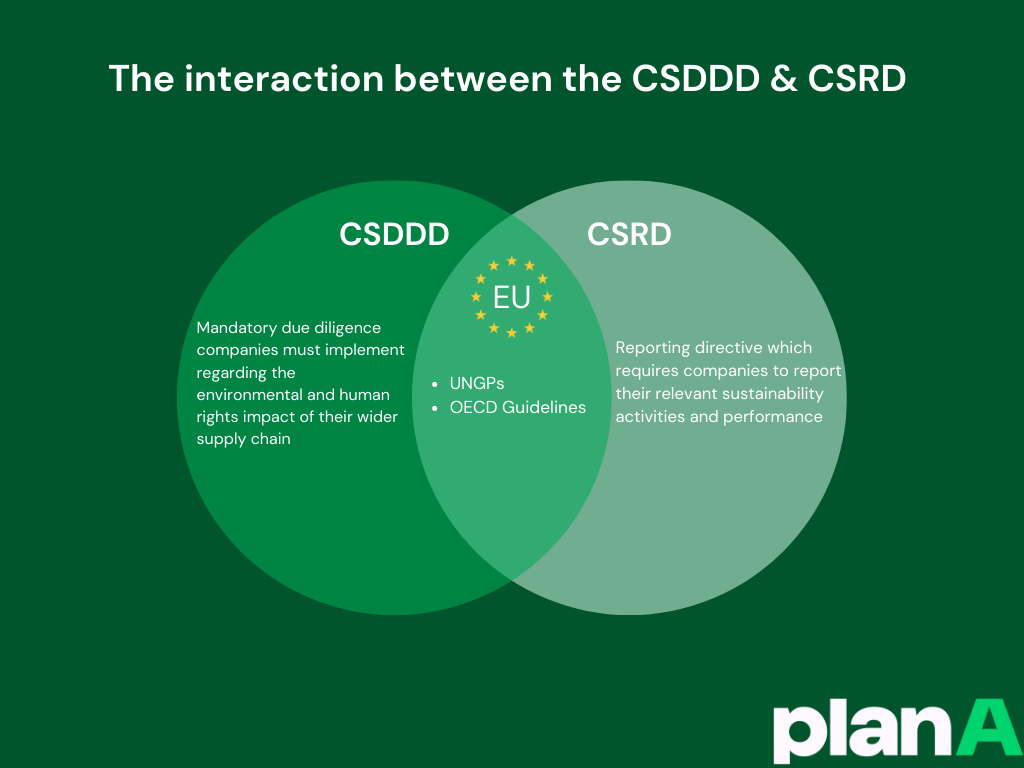
- The Corporate Sustainability Due Diligence Directive (CSDDD/CS3D Directive).
Collectively, these measures are referred to as the Directives; they impose a responsibility on corporations to exercise due diligence to mitigate adverse effects on human rights and the environment, both within their operations and throughout their value chains. The onus is on individual member states to implement them in their regions.
What Is The CSRD?
The CSRD is an update to the Non-Financial Reporting Directive (NFRD), which required large companies in the EU to disclose non-financial information, including information on their ESG policies and performance. The CSRD introduces more detailed sustainability reporting requirements for companies, including mandatory reporting on a broader range of ESG indicators.
For large companies already subject to NFRD, the CSRD regulation will apply from 1 January 2024, while larger companies not already subject to the NFRD will see the regulation apply from 1 January 2025. Smaller organisations should expect to have to comply from 2026.
What is the CSDDD?
Meanwhile, the draft proposal for the Corporate Sustainability Due Diligence Directive (CSDDD) was approved in June 2023. Under the CSDDD, companies must engage in a reasonable due diligence process within their operations and across their entire supply chains to prevent or reduce human rights issues and specific environmental risks.
Additionally, organisations are expected to take decisive action to rectify human rights violations or environmental offences if they occur. Depending on the progress of negotiations with the member states, due diligence obligations may apply as soon as 2025.
What is the EU taxonomy regulation?
Apart from the Directives, the EU also passed the EU Taxonomy Regulation — a framework to establish minimum standard reporting requirements and uphold transparency over which investments or activities can be considered sustainable.
Activities are classified as taxonomy-eligible concerning six environmental objectives, including climate change mitigation, pollution prevention and transition to a circular economy. Taxonomy alignment can be achieved by committing to minimum social safeguards around worker and human rights, for example.
The EU Taxonomy regulation is being phased in by sector, starting with finance back in 2020 and followed by industries such as construction, manufacturing and transport over recent years. It is expected to incorporate new sectors as well as SMEs from 2024.
Related reading: Sustainability and construction: What does sustainable construction mean?
ESG laws in Germany
Source: Circularise Software
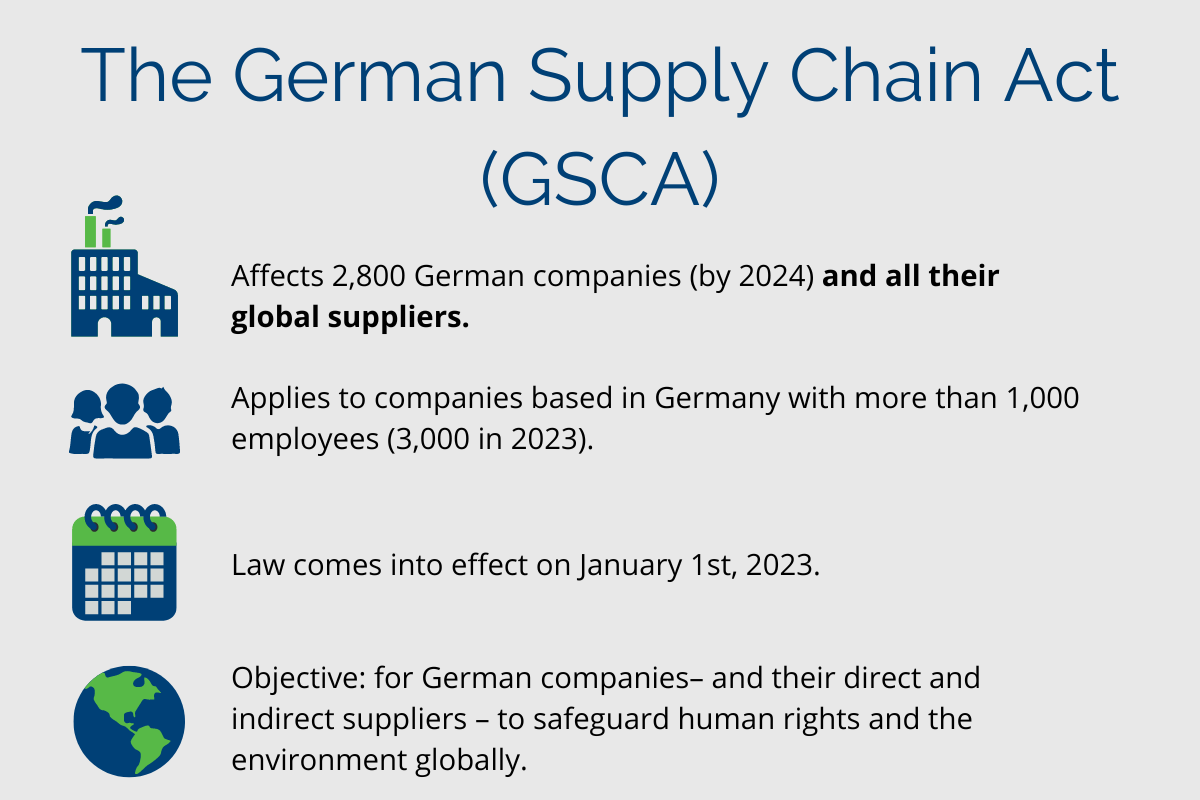
Pre-empting the supply chain due diligence legislation currently in draft for the EU, the German Supply Chain Due Diligence Act (GSCA) came into force on 1 January 2023. It obligates companies to assess and conduct due diligence on human rights and environmental risks across their supply chain.
The GCSA applies to any company employing over 3,000 staff (dropping to 1,000 from 2024) with a registered branch office in Germany. The Act applies to all suppliers, direct or indirect, so if there is any German customer within the supply chain, they will be impacted by the Act, and compliance with GCSA will need to be ensured.
ESG legislation in the United Kingdom
While the UK has yet to adopt any specific ESG laws, there are laws that shape the landscape of Great Britain’s ESG directives. These include:
- UK Corporate Governance Code 2018
- The Companies Act 2006
- The Climate Change Act 2008
- The Equality Act 2010
- The Modern Slavery Act 2015.
Company law in the UK is mainly set out in the Companies Act 2006, and in 2016, the EU’s NRFD was implemented as an amendment to this Act. The NRFD applies to all large public interest companies with more than 500 employees and mandates disclosure on environmental, social and employee, human rights, anti-corruption and bribery issues through annual reporting.
Meanwhile, the Financial Conduct Authority (FCA) is forging ahead with its mission to build transparency and trust around sustainability via its Sustainability Disclosure Requirements (SDR) and investment labelling, which includes restrictions on “greenwashing.” This includes the misleading use of sustainability-related terms such as “ESG”, “green” or “sustainable” in product naming and marketing. Their policy statement is currently due for publication by the end of 2023.
Related reading: How is sustainability ranked in the construction industry?
ESG regulations in the United States
The USA is also making headway in tightening ESG disclosure and standardisation regulations. The US Securities and Exchange Commission (SEC) announced the creation of a climate and ESG task force which will aim at ESG-related misconduct, in particular, greenwashing.
Other legislation in development by the SEC includes a rule on climate disclosure for publicly traded companies to report annually on how their businesses assess, measure and manage climate-related risks, including greenhouse gas emissions.
ESG regulations across the rest of the world
ESG legislation in China
In China, ESG-related Amendments to the Disclosure Rules Applicable to Listed Companies remain the leading ESG legislation. Still, a growing number of Chinese companies are now issuing annual ESG reports voluntarily; in mid-2020, 1,021 companies listed in RMB on the Shenzhen and Shanghai stock exchanges had published annual ESG reports — up from 371 companies in 2019.
ESG regulations In Australia
Elsewhere, 2023 has seen the Australian government consult on developing a climate risk disclosure framework for companies and financial institutions, with plans to introduce mandatory sustainability and ESG reporting requirements for large companies in the next few years.
ESG laws in the UAE
The UAE has also been proactive over recent years. Although their regulations presently focus on listed or financial services organisations, broader obligations on sustainability reporting look set to come into force on all publicly and privately listed companies.
Investors and consumers increasingly question businesses across the Middle East about their ESG credentials, and tackling greenwashing has become a hot topic as one of the region’s bigger challenges.
International efforts to bolster ESG
A comprehensive worldwide standard for assessing and disclosing the full spectrum of ESG issues does not yet exist, but several voluntary frameworks and guidelines do. This includes the UN Guiding Principles on Business and Human Rights, the Global Reporting Initiative (GRI) and the International Sustainability Standards Board (ISSB), which issued its inaugural standards in June 2023.
Global regulations emphasise the importance of ESG
The pressure to maintain transparency and demonstrate a genuine commitment to ESG issues will only intensify for businesses and their supply chains operating in global markets. Being proactive is, therefore, essential for building resilience and mitigating risk. The more companies can do now to improve supply chain transparency and build ESG monitoring and management into their risk management processes, the better prepared they will be for the future. As a leading provider of supply chain risk management services, CHAS can help you manage your supply chain and achieve greater levels of sustainability.
Find more guidance on ESG by reading CHAS Insights. ESG is one of the key areas assessed under our certification solutions, such as the Common Assessment Standard. By becoming a CHAS Client, you can match with contractors backed by the Common Assessment Standard, allowing you to efficiently meet your supply chain’s ESG goals. Speak to a CHAS advisor today to learn more.