

The newly released HSE statistics for 2025 offer clear insights into the risks facing workers across Great Britain and the scale of the challenge that organisations must collectively address.
This year’s figures highlight rising cases of work-related ill health, consistently high levels of musculoskeletal disorders, and preventable injuries that continue to disrupt lives and industries. For sectors such as construction, manufacturing, and the public sector, the data serves as a crucial guide for identifying where targeted interventions can have the greatest impact.
Below, we break down the headline findings from HSE’s Health and Safety Statistics 2024/25 and explore what they mean for organisations aiming to strengthen compliance, reduce risk and protect their workforce.
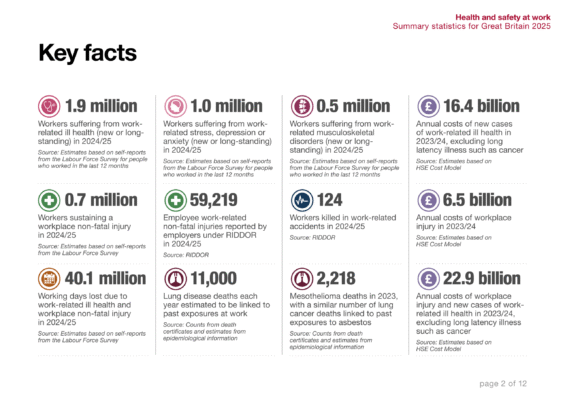
1. Work-Related Ill Health: 1.9 Million Workers Affected
The latest health and safety statistics show 1.9 million workers dealing with work-related ill health, a number that continues to exceed pre-pandemic levels.
Stress, Depression And Anxiety Remain The Leading Causes
- 964,000 workers affected
- 409,000 new cases in 2024/25
- 22.1 million working days lost.
Public administration, education, and human health/ social care show statistically higher rates than the all-industry average. These are key sectors for Veriforce CHAS clients, many of whom require robust well-being, training and risk-management practices to meet client expectations.
Musculoskeletal Disorders (MSDs): 511,000 Workers Affected
- 173,000 new cases
- 7.1 million working days lost
- Most affected areas are the back (43%) and upper limbs/neck (41%).
For organisations seeking manual handling injury statistics in the UK or the percentage of workplace injuries caused by manual handling, this dataset confirms that handling, lifting, and carrying remain major contributors to harm, especially in construction, manufacturing, and transport/storage.
Related reading: Manual Handling Of Equipment: 8 Best Practices To Prevent Injury
Work-Related Breathing And Lung Disorders
- 11,000 deaths linked to past exposures
- 2,218 mesothelioma deaths in 2023
- 22,000 new cases of work-related lung issues.
These figures reinforce the importance of COSHH compliance, proper respiratory protection, and effective exposure control measures in high-risk environments, such as worksites with the presence of asbestos.
Related reading: What Is COSHH? Hazardous Substance Control Explained
2. Workplace Injuries: 680,000 Workers Hurt In 2024/25
Workplace injuries remain a persistent challenge across the UK industry, affecting people, productivity and operational continuity. The 2024/25 figures show that around 680,000 working people sustained an injury at work. Even well-managed sites and offices can still be vulnerable to everyday hazards such as slips, manual handling and being struck by moving objects.
These incidents not only cause personal harm but also interrupt projects, reduce workforce availability and create administrative burdens for businesses. Understanding the most common injury types and their occurrence is essential for targeting prevention and reducing both human and operational costs. Despite long-term improvements, the HSE statistics for 2025 show workplace injuries remain a major challenge:
- 680,000 workers sustained a non-fatal workplace injury
- 124 worker fatalities in work-related accidents
- 59,219 RIDDOR-reportable injuries
- 4.4 million working days lost due to non-fatal injuries.
Related reading: What Does RIDDOR Stand For In Health And Safety?
What’s causing these injuries?
While injuries often receive the most attention, work-related ill health affects far more people and has a deeper long-term impact on the workforce. Conditions such as stress, musculoskeletal disorders, and respiratory issues can develop gradually, making them harder to detect and even harder to resolve.
The 2024/25 data shows that chronic ill health continues to be one of the most significant challenges facing UK employers, not only reducing workers’ quality of life but also driving millions of lost working days each year. Recognising the root causes of ill health is the first step toward building healthier, more resilient workplaces.
Employer RIDDOR reports show:
- Handling, lifting or carrying — 30%
- Slips, trips and falls on the same level — 17%
- Struck by a moving object — 10%
- Acts of violence — 10%
- Falls from height — 8%.
These risk categories closely align with those that Veriforce CHAS members manage on a daily basis across high-injury-risk sectors. In construction, for example, organisations routinely face fall hazards and the dangers involved in lifting operations, which require robust controls and continuous monitoring. Within manufacturing, businesses must contend with machinery-related risks, manual handling challenges, and the potential for contact injuries, making structured safety management a crucial component.
The public sector also faces significant risk exposure, particularly in areas such as slips and trips in public environments, incidents of violence or aggression, and ergonomic strain among frontline and office-based staff. Each of these sectors benefits from clear, consistent safety standards, exactly the type supported through Veriforce CHAS certification.
Free Risk Assessment Template
Take the stress and confusion out of creating a risk assessment with our free template.
Enter your details, and we’ll email you a risk assessment template that’s both compliant and comprehensive to use.
By submitting this form you confirm you are happy to be contacted by CHAS in accordance with our Privacy Policy
3. The Economic Cost: £22.9 Billion In 2023/24
The HSE statistics also quantify the financial and human impact of workplace harm. The figure stands at an estimated £22.9 billion total annual cost of injuries and new cases of ill health. This is split as the majority, £16.4 billion, from ill health and £6.5 billion from injury.
Most costs (around £13.4 billion) are borne by individuals, whereas employers incur £4.3 billion, and the government absorbs £5.2 billion. These numbers highlight how investing in risk management, training and compliance systems is significantly more cost-effective than responding to incidents after they occur.
4. High-Risk Industries: Where The Data Points
The latest workplace injury statistics UK show sectors with statistically higher rates of injury include:
- Accommodation and food services
- Construction
- Transportation and storage
- Wholesale and retail.
Industries with higher-than-average ill health rates include:
- Public administration and defence
- Human health and social work
- Education.
This makes the new HSE statistics particularly relevant for Veriforce CHAS clients, many of whom operate in areas with elevated risk profiles and tight procurement scrutiny.
5. MSDs, Manual Handling And Sector Impact
The percentage of workplace injuries caused by manual handling has remained the same as in 2024 at 17%. The report identifies handling, lifting or carrying as the second most common kind of accident.
This is particularly important for:
- Construction — material handling, repetitive lifting
- Manufacturing — line work, awkward loads
- Public sector — care environments and facilities.
Manual handling training, ergonomic assessment, and safe-system updates remain essential controls.
6. Occupational Health Risks: Long-Term Trends
The HSE statistics show:
- Mesothelioma deaths are projected to decline gradually by 2040
- Rates of occupational asthma remain broadly constant
- Lung disease deaths continue to account for the majority of long-latency fatal harm.
This highlights the continued need for:
- Effective monitoring
- Worker training
- Exposure control
- Safe asbestos management.
Related reading: What Is Occupational Health And Safety?
7. International Comparisons: The UK Remains Among The Safest
While the UK compares favourably with the EU-27 in fatal and non-fatal injury rates, the persistently high levels of stress, MSDs and work-related illness underline that there is still significant work to be done.
What This Means For Organisations
The 2025 HSE statistics make one thing clear: ill health and preventable injuries continue to present significant operational, financial and human challenges across all major UK industries. For organisations in consistently high-risk sectors such as construction, manufacturing and public services, the key opportunities lie in strengthening their approach to workforce health and safety in line with statutory requirements.
The 1974 Health and Safety at Work Act (HSWA) requires employers to protect workers “so far as is reasonably practicable,” and the latest data highlights where improvements will have the greatest impact.
One of the most significant areas is well-being and mental health support. Stress, depression and anxiety continue to account for a high proportion of work-related ill health cases, placing clear obligations on employers under the Management of Health and Safety at Work Regulations 1999 to assess and control psychosocial risks. Organisations that proactively identify workload pressures can reduce sickness absence, protect productivity and demonstrate compliance with HSE’s Management Standards for stress.
Improving manual handling and ergonomic controls also remains a critical requirement. Musculoskeletal disorders (MSDs) consistently rank among the top causes of lost working days, and employers are required to assess and control these risks under the Manual Handling Operations Regulations 1992. Implementing ergonomic assessments and providing training on safe lifting techniques are essential interventions that directly support legal compliance while reducing avoidable injuries.
Exposure to hazardous substances remains a significant driver of both acute and long-term ill health, necessitating the implementation of robust systems under the Control of Substances Hazardous to Health Regulations 2002. Strong COSHH controls not only protect workers but also demonstrate that an organisation is meeting regulatory expectations.
Reducing slip, trip and fall hazards remains essential in all workplaces. These remain one of the most common causes of non-fatal injuries reported under RIDDOR and directly fall under employers’ obligations to maintain safe workplaces as required by the Workplace (Health, Safety and Welfare) Regulations 1992. Effective housekeeping, safe access routes, appropriate flooring, and clear site management significantly minimise these incidents and help organisations meet their duty of care.
Organisations benefit from embedding comprehensive risk-management systems that integrate all of these elements into a structured framework. Employers are required to have arrangements for planning, organisation, control, monitoring, and review. A coherent risk-management system ensures these duties are consistently met and documented.
How Veriforce CHAS Supports Organisations Responding To The New HSE Statistics
We provide organisations with practical, structured support to help them meet their legal obligations and demonstrate compliance with recognised industry standards.
Our health and safety assessment, aligned with established industry requirements, enables organisations to benchmark their current systems against best practice and regulatory duties. This ensures that arrangements for risk assessment, safe systems of work, training, reporting and monitoring meet the standards required under key legislation.
Veriforce CHAS also provides guidance on priority risk areas, including manual handling, COSHH, stress management, workplace transport and other topics highlighted by the latest HSE data. This helps employers strengthen their internal controls, close compliance gaps, and proactively address the causes of workplace injury and ill health.
Finally, Veriforce CHAS supports supply chain assurance by enabling organisations to verify that contractors and suppliers meet the required health and safety standards before entering into working relationships. This is essential for reducing risk, meeting client expectations and maintaining legal compliance in environments where multiple dutyholders share responsibility.
Learning From The Workplace Safety Statistics
The new HSE statistics 2025 offer a stark but invaluable insight into where harm is occurring, who is being affected, and what organisations must prioritise to protect workers. With ill health on the rise, MSDs persisting, and injury numbers still significant, the focus must remain on shared responsibility, proactive management and building safer, healthier workplaces.
Veriforce CHAS supports organisations across the UK to meet these challenges head-on. Join Veriforce CHAS to strengthen compliance, support worker well-being, and reduce risk today and into the future.
Get A Free Health Surveillance Template
Are you wondering whether you should adjust your Health Surveillance procedures for your project?
Enter your details to download our free Health Surveillance Template.
By submitting this form you confirm you are happy to be contacted by CHAS in accordance with our Privacy Policy

