


As UK industries continue to warn about chronic skills shortages, Alex Minett, Head of Products and Markets at CHAS, a Veriforce company, looks at what is driving the problem and what businesses can do to meet the challenge.
The skills shortage has been a developing issue for the UK economy. Even pre-pandemic companies struggling to recruit employees with the necessary skills to shore up future business growth were sounding alarm bells. Indeed, a 2019 Learning and Work Institute report suggested that the lack of output caused by the UK skills shortage could cost the country £120 billion by 2030.
Source: Federation for Small Businesses
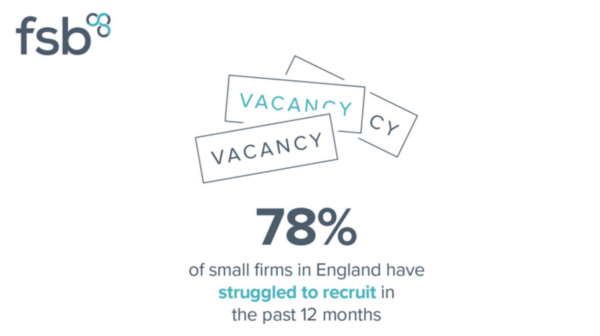
Post-pandemic, the picture looks tougher still. At the end of 2022, a Federation for Small Businesses (FSB) survey found that 78% of small businesses in England struggled to recruit over the last 12 months. The report also showed that 82% of job applicants lacked the relevant qualifications, new skills and experience to fill vacant roles. This problem has been compounded by a generally low number of skilled worker applicants in England.
Overall, the latest government figures indicate there are 1.19 million job vacancies in the UK — equal to those currently unemployed.
What Is A Skills Shortage?
A skills shortage refers to a situation where there is a scarcity or insufficient supply of workers with specific skills or qualifications in a particular industry, region, or country. It occurs when the demand for certain skills exceeds the available pool of qualified individuals who possess those skills. This creates skills gaps that cause businesses to have difficulties in finding and recruiting individuals with the required expertise to fill vacant positions.
Learn More About The Common Assessment Standard
The Common Assessment Standard is the highest recognised compliance accreditation in construction, facilities, housing, social care and education.
Discover what it is and how it can benefit your organisation, creating new opportunities and growth for your business.
Enter Your Details For A Callback On The Common Assessment Standard.
By submitting this form you confirm you are happy to be contacted by CHAS in accordance with our Privacy Policy
Which Industries Are Most Affected By Labour Shortages?
Unsurprisingly, almost all parts of the UK economy face skill shortages. According to the last skills survey published by the Department for Education, vacancies are highest in the construction and manufacturing sectors, where 36% of vacancies are proving hard to fill because applicants lack the appropriate skills, qualifications or experience. According to the Construction Skills Network (CSN), an extra 217,000 workers will be needed by 2025 to meet the demand for construction output.
Related Reading: Tackling the Skills Shortage in Construction
The UK engineering sector and the oil and gas industry are also seeing increasing vacancy rates, not least because it’s an industry that generally demands highly developed skills at entry level as standard.
What’s Driving the UK’s Skills Shortages?
Unsurprisingly, the UK’s skills shortage problem is complex, with multiple compounding factors. Here are some of the issues driving these skills challenges.
1. Fewer People Available To Work
The biggest factor driving the UK’s skill shortage is a general shortage in labour supply, which the government attributes to several factors. In other words, it’s not just that businesses are having difficulty finding people with the required skills — there are simply not enough people available to work in the UK.
For instance, data from the Office of National Statistics for the quarter leading up to January 2023 shows the main reasons for people not working is that they are either; in long-term sickness (28%), in further education (25%), required to look after family/home (19%) or they are retirees (12%)
2. Ageing Workforce In Certain Sectors
Source: Chartered Institute of Building
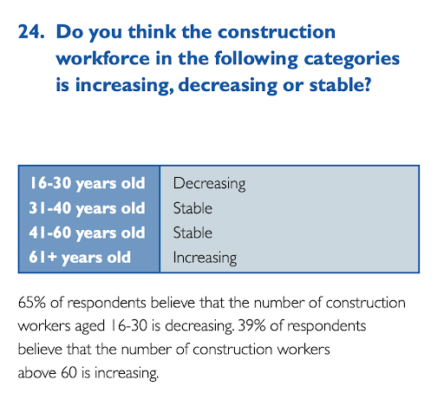
The ageing workforce is felt most acutely in sectors like construction, transport and logistics, where increasingly fewer people are entering the industry to replace those nearing retirement. According to the Chartered Institute of Building (CIOB), the number of employees over 60 is increasing more than any other age group — an observation confirmed by 39% of respondents in the study.
The result is an expanding gap in skilled workers and a decline in mentors who can offer knowledge transfer to recruits.
Related Reading: What Trades Are In Demand In The UK?
3. COVID-19 And Brexit
The pandemic and Brexit were also mitigating factors in the UK’s labour shortages. Recovery from COVID-19 has seen unprecedented demand in labour far outstripping supply. At the same time, the pandemic was said to have prompted “The Great Resignation” — a movement that has seen people reassess the role of work in their lives. This has led to many workers changing careers entirely or seeking options that offer remote working and more flexibility.
Meanwhile, the Bank of England cites slower population growth as a reason for the skills shortage, partly due to lower net migration from the EU. Many sectors, such as engineering, report a significant loss of EU-based talent following Brexit, leaving large gaps in the workforce as EU workers have departed and immigration red tape has meant fewer EU applicants.
4. New Technologies Calling For More Than Just Basic Digital Skills
Another contributing factor to the labour shortages is the rapid rise in new and innovative technology, particularly in industries like manufacturing which is seeing an increasing need for workers to be skilled in areas such as robotics and automation. Experienced workers nearing retirement age may not see the benefit of gaining new digital skills, which may even contribute to early-retirement decisions.
What Is The Impact Of Skill Shortages?
The economy is feeling the impact of the skills shortage in terms of growth and productivity. In industries such as construction, where trades like carpentry, bricklaying, plumbing and electrics are in high demand and short supply, house-building targets and infrastructure projects could face jeopardy. Recent data from the Federation of Master Builders State of Trade survey shows that 60% of jobs have stalled due to labour shortages.
But the labour market squeeze also has several specific effects on UK businesses. We look at a few of them below.
Related Reading: Seven Issues That Will Affect Supply Chains in 2023
1. Impaired Customer Service
For UK businesses, turning down work because of inadequate training and skills gaps can have significant consequences on customer relations — more so if your organisation cannot meet contractual obligations.
In industries where specialised skills are essential for delivering exceptional service, businesses struggling with talent gaps may fail to meet customer expectations, leading to dissatisfied clients and a damaged reputation. In many cases, businesses are forced to pay a premium on in-demand talent (e.g., consultants and subcontractors), causing projects to go over budget or schedule, affecting both clients and contractors in the supply chain.
2. Increased Recruitment Costs
Difficulties in recruiting staff lead to an increase in recruitment costs. Stop-gap solutions such as temporary staffing come with higher rates, while it’s not unusual for businesses to overpay on salaries to secure the skills they need. There’s also the risk that standards fall when there’s less choice. Therefore, ensuring compliance across workforces and the wider supply chain should remain a priority for companies to avoid negative repercussions.
3. Increased Workload And Employee Burnout
In organisations facing skill shortages, existing employees often shoulder additional responsibilities and workloads. This increased pressure can lead to fatigue, stress, and burnout among the workforce.
Overburdened employees may experience decreased job satisfaction, diminished morale, and an increased likelihood of turnover. The loss of experienced employees further exacerbates skill shortages, creating a vicious cycle that negatively impacts business operations.
4. Rising Labour Costs
The demand for skilled workers often outpaces the supply, leading to upward pressure on wages. Businesses struggling with skill shortages may be forced to offer higher salaries to entice qualified professionals, which can significantly increase labour costs. The increased expenses associated with recruiting and retaining skilled employees can erode profit margins, making it challenging for businesses to invest in other areas such as innovation, technology, and expansion.
5. Reduced Innovation And Growth
Skill shortages can stifle innovation and hinder business growth. Skilled professionals bring fresh perspectives, specialised knowledge, and creative problem-solving abilities to organisations. When such talent is scarce, businesses may struggle to develop and implement new ideas, technologies, and strategies. This lack of innovation can hinder competitiveness and hamper growth opportunities, ultimately impacting the long-term sustainability and success of the business.
What Can Be Done To Plug Skills Gaps?
Addressing the skills shortage requires a combination of government policy, business adaptation and a sharper focus on education, training and upskilling.
The government has already launched several initiatives to increase vocational training in key industries. Meanwhile, there are indications that individual construction trades are under review to join some engineering roles on the skilled worker shortage occupation list, allowing companies to access special visas to employ overseas workers to fill the gap.
In the interim, businesses can turn to these strategies to improve their chances of finding people with the necessary skills.
1. Review Your Recruitment Strategies
A good starting point for businesses would be to review recruitment strategies to attract skilled workers. In an industry such as construction, where the perception of it being driven by the middle-aged white man is not, statistically speaking, far from reality, attracting a more diverse workforce could have a transformative impact on the skills gap.
Challenging issues such as gender inequality will make any male-dominated industry more appealing to women. While adopting family-friendly work policies and benefits, including flexible working arrangements, job-sharing and hybrid working, demonstrates an overall engagement with modern employee expectations.
Related Reading: How to Improve Equality and Diversity in the Workplace
2. Open Your Doors To Young Talent
Attracting young people should be high on the agenda for businesses too. Often young people need to be made aware of the breadth of career pathways available to them in the affected industries. As a generation that has grown up with technology, digital awareness is crucial to plugging the digital skills gap that might threaten growth and innovation.
Businesses that take the opportunity to engage with local schools and colleges, imparting the knowledge and inner workings of their sectors, will be exposing students to career opportunities they may not have previously considered. And with the tide turning on the perception of academic qualifications being of higher value than vocational ones, investing in apprenticeship recruitment drives could be one of the keys to future business security.
3. Work On Talent Retention And Upskilling
However, companies must do more than lean on recruitment to solve the gap. Retention strategies should focus on upskilling the existing workforce to broaden their skill sets. Improving the training available to existing workers benefits the company and opens up opportunities for workers previously hired at a lower level.
This worker investment is also an attractive selling point when appealing to potential employees. Seeing a clear path for progression and commitment from companies to the advancement of staff will incentivise more people to join sectors suffering from skills shortages.
Look At Supply Chain Compliance Opportunities
In terms of the wider supply chain, increasing the emphasis on collaboration to support businesses to raise compliance levels is a more progressive direction rather than simply laying down the law.
Good business is about working together. Companies are increasingly choosing to work with supply chain partners like CHAS, who can help buyer-based clients upgrade their network of contractors to higher levels of compliance. Clients also get access to the CHAS Jobs Board, where they can share job postings with our database of 33,500+ prequalified contractors.
Bringing It All Together
The skills shortage remains an ongoing challenge for the UK, but businesses can play their part in the rescue operation in many ways. Adaptation and forward-thinking are strategically vital. Increased pay is no longer just an incentive on its own, with employees now looking for improved benefits to enhance a better work/life balance. Recognising the importance of inclusion and diversity will open doors to recruits and retain existing ones. While keeping sight of compliance obligations ensures standards remain high.
Overall, organisations demonstrating they invest in their responsibilities are more likely to avoid future skills shortages. It will leave them better equipped to retain and develop talent while attracting new prospects.
Be sure to follow the CHAS blog for more guides and insights on managing risk in your supply chain. To address the threat of skills shortages to your organisation, become a CHAS client to find suitably qualified contractors or suppliers with Verified Supplier, SSIP, or Common Assessment Standard accreditation.

