


The UK construction skills shortage has reached a point where 75% of contractors are now having problems recruiting skilled workers. In this guide, we break down the problem and offer some solutions.
The UK construction industry is facing a severe skills shortage that’s affecting the ability of construction firms, contractors and subcontractors to deliver projects on time and under budget. This problem has been years in the making and is only expected to worsen in the coming years. According to a Construction Skills Network (CSN) report, an extra 217,000 workers will be needed by 2025 to meet projections for construction output.
But to fully understand the problem, it’s essential first to understand what a skills shortage is and how it affects the construction industry.
What Is The Construction Skills Shortage?
In the construction industry context, a skills shortage refers to a situation where there is a scarcity or insufficient supply of workers with specific skills or qualifications needed in various construction-related roles.
It occurs when the demand for qualified workers with construction skills, such as carpentry, plumbing, electrical work, and engineering, surpasses the available pool of qualified individuals with those specialised skills. The construction industry relies heavily on skilled workers to deliver projects on time, within budget, and to the required quality standards. However, when faced with a skills shortage, construction companies struggle to find and recruit workers with the necessary expertise, resulting in project delays, increased costs, and compromised project outcomes.
It’s worth noting that a skills shortage is more than just a reference to the level of qualification a candidate requires. It also includes challenges in the UK labour market, such as:
- Difficulty in finding the right person for a job in the necessary location
- Difficulty in hiring workers at the cost an employer can afford
- Difficulty in finding workers that agree with the terms of employment.
According to the CSN report referenced earlier, the UK’s construction industry is projected to require approximately 45,000 additional workers annually over the next five years. This escalating demand comes when companies are already grappling with unfilled vacancies, marking this period as the most severe skills shortage the industry has faced in two decades.
Why Is There A Labour Shortage In The Construction Industry?
The construction skills shortage is a crisis that has gnawed at construction companies for many years. The specific reasons for this labour squeeze are varied and encompass factors such as:
Ageing Construction Workers And Industry Professionals
An ageing workforce is one of the main reasons for the UK construction skills shortage. According to data from the Office for National Statistics (ONS), approximately 20% of workers in the UK construction sector are aged 50 or older.
Considering the physically demanding nature of the profession, it is likely that these experienced workers will exit the industry within the next decade or so, if not sooner. And as construction workers reach retirement age, fewer people are entering the industry to replace them.
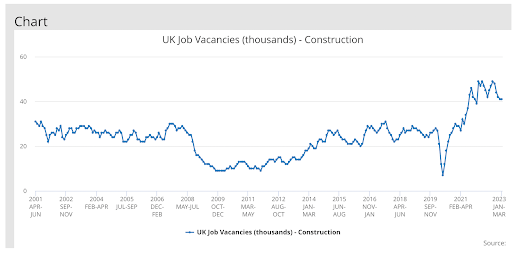
Source: Office For National Statistics
The COVID-19 pandemic further accelerated this trend, with many furloughed individuals taking the opportunity to reflect on their careers and opt for early retirement. This aligns with ONS figures showing that job vacancies in the construction sector soared around the same as the pandemic started.
Lack Of Training And Apprenticeships
In 2022, the Financial Times reported that only 713,000 people were registered as apprentices in the previous year — the lowest annual total since 2010. Worse, nearly half (42%) failed to complete their course.
This figure pales compared to countries renowned for their effective youth training programs, such as Germany. In Germany’s Dual System, over 60% of school leavers actively participate in apprenticeships, emphasising the country’s commitment to cultivating young talent through practical vocational training.
This brings us to the next point.
Young People Aren’t Attracted To The Construction Sector
There is a noticeable lack of interest among young people in pursuing careers in the construction industry. This can be attributed, at least in part, to the prevailing perception that working in construction is undesirable. Polls indicate that a mere 5% of students actively contemplate pursuing roles within the construction sector.
Related Reading: What Trades Are In Demand In The UK?
Brexit
The UK construction industry has mitigated its domestic skills shortage by attracting foreign workers and skilled professionals. However, the advent of Brexit has introduced new complexities for EU nationals seeking employment in the UK, requiring them to undergo an expensive and convoluted visa application process.
Furthermore, the UK faces stiff competition for skilled workers from countries such as the United States, Canada, Germany, and Australia. Potential migrants may also be deterred by the UK’s relatively high cost of living compared to wages, adding to the difficulties of attracting talent from abroad.
Related Reading: The Ultimate CHAS Guide To Managing The UK’s Skills Shortage Problem
Learn More About The Common Assessment Standard
The Common Assessment Standard is the highest recognised compliance accreditation in construction, facilities, housing, social care and education.
Discover what it is and how it can benefit your organisation, creating new opportunities and growth for your business.
Enter Your Details For A Callback On The Common Assessment Standard.
By submitting this form you confirm you are happy to be contacted by CHAS in accordance with our Privacy Policy
What Are The Effects Of The Skilled Labour Shortage In Construction?
Increased Project Costs
Increased costs are easily the biggest effect of the labour shortage in the construction industry. The demand for skilled professionals outstrips supply, resulting in fierce competition among employers to attract and retain talent. This competition leads to increased wages and benefits to entice workers, placing financial strain on construction companies.
Figures from the Department for Business, Energy and Industrial Strategy show that the shortage in skilled tradespeople has caused wages for carpenters, groundworkers, bricklayers, plasterers and plant operators, among others, to rise by 6%. The rising labour costs can negatively affect profit margins, reduce investment in new projects, and make it harder for companies to remain competitive in the market.
Safety Risks
The skills shortage in construction can pose significant safety risks. Skilled workers often possess specialised knowledge and training in adhering to safety protocols and regulations.
When companies face a shortage of skilled workers, there may be an increased likelihood of inexperienced individuals working on construction sites, potentially leading to an elevated risk of accidents and injuries. Ensuring a skilled workforce is crucial for maintaining safe working environments and preventing hazardous situations.
Compromised Project Quality
The skills shortage in the construction industry can compromise the quality of completed projects. When companies are unable to find skilled workers, they may have to hire less experienced or underqualified individuals. This can result in a lower standard of workmanship, increased errors and rework, and reduced overall project quality.
Damage To Reputation
Skills gaps and insufficient workers may cause you to turn down work, which can have major consequences on your reputation. Things get worse if you find yourself accepting contracts but, due to labour constraints, cannot fulfil your contractual obligations.
What Can Be Done To Tackle The Skills Shortage?
The solution to the skills shortage in construction is making a career in the industry seem desirable. Tackling the UK skills shortage in construction must start with changing industry perceptions. Construction firms can use a few tactics to mitigate the construction skills shortage.
Open Your Doors To Young Workers
The construction industry must focus on enhancing its reputation to attract the interest of young people. This can be done by highlighting the industry’s crucial role in achieving the UK’s net zero targets, showcasing the presence of creative and innovative positions, and highlighting the potentially lucrative opportunities awaiting tradespeople.
With careers in digital technology being an increasingly popular choice for young people, modernising construction techniques will increase the appeal for young people prioritising forward-thinking and longer-lasting roles when choosing a career path.
Embrace Equality, Diversity And Inclusion
The skills shortage in construction may be partly down to some demographics feeling like the industry is not the place for them. Construction also has a reputation for being an industry of middle-aged white men; statistically, it isn’t far off.
Widening the talent pool for recruitment is just one of the many benefits of a diverse workplace, and diversifying the workforce will help to stop limiting the kinds of people who typically enter the industry. Pushing back against the perceived idea that construction is a “boy’s club” and challenging gender inequality in construction will make the industry more appealing to women, vastly increasing the number of people interested in a career in construction.
Related Reading: How to Improve Equality and Diversity in the Workplace
Don’t Underestimate Apprenticeships
Collaboration is key in working with local communities at a grassroots level to enthuse people about careers in the UK construction sector. This is where education and schooling come in, allowing companies to promote a career in construction to students from a young age.
According to the Open University’s Business Barometer 2022, among organisations that already use apprenticeships, 32% plan to increase the number of apprentices hired over the next 12 months. This is an approach that 22% of surveyed organisations use to bridge their skills gaps.
Invest In Employee Education And Upskilling
Re-education is also key here in the form of upskilling existing workers to broaden their skill sets. Investing time and resources into current staff is a huge opportunity for construction companies to make the most of the workers they already have. A new stream of workers is vital, but those already in the industry should not be overlooked. Improving the training available to existing workers benefits the company and also opens up opportunities to workers previously hired at a lower level.
This investment into workers is a great selling point when appealing to potential employees, as progression is essential to people when considering a career path. Seeing a clear way for progression and commitment from construction companies to the advancement of staff will incentivise more people to join the sector.
Be sure to follow the CHAS blog for more insights on managing supply chain risks, such as the skills shortage. If you need help mitigating skills shortages in your organisation, become a CHAS client to access our network of 32,500+ prequalified contractors and suppliers with Verified Supplier, SSIP, or Common Assessment Standard accreditation.

