


Since 12 February 2024, “major” developments have been required to adhere to the new Biodiversity Net Gain (BNG) requirements under the Environmental Act 2021. But smaller sites have been granted a grace period until 2 April to make the necessary adjustments. Lucy Dixon, ESG Sector Lead at Veriforce CHAS, shares insights for developers of smaller sites aiming for compliance.
As of 12 February 2024, all planning permissions in England, with limited exceptions and excluding small sites (for now), must comply with the biodiversity net gain (BNG) legislation — a key provision of the Environment Act 2021. Smaller developments have until 2 April 2024 to comply with the policy.
This change now makes it compulsory for “major” developments to demonstrate a minimum 10% increase in biodiversity to get planning permission. To do so, developers must submit proposals to their local planning authority (LPA), outlining how their development will achieve a net gain in biodiversity. However, some LPAs may require BNG levels beyond the 10% threshold.
For major developers, integrating biodiversity net gain into their project designs is not an entirely new concept. However, for smaller projects, the impact of this policy may be more deeply felt. Limited resources, financial constraints and restricted space for implementing measures to offset biodiversity loss could all impede the feasibility of developing small sites.
Related Reading: Highlighting the Positive Effects of Construction on the Environment
What Is Biodiversity Net Gain?
The term “biodiversity” comes from “biological diversity,” encompassing the vast array of living entities, including animals, insects, plants, bacteria and fungi. Biodiversity net gain is a method applied in development projects to ensure that wildlife habitats are significantly improved following the development, compared to their previous state. In other words, BNG means leaving an area better than it was before the development existed.
In England, BNG has become a compulsory requirement under Schedule 7A of the Town and Country Planning Act 1990, later amended by Schedule 14 of the Environment Act 2021. Developers are now required to achieve a BNG of 10%, indicating that any development must enhance the site’s natural habitat, making it more abundant or of higher quality than before the development.
Related Reading: Recent Developments In Global Environmental, Social, Governance (ESG) Regulations
Five Facts About Biodiversity Net Gain For Small Developers
To help small developers get to the heart of biodiversity net gain regulations, we’ve compiled a list of five key facts about BNG and its impact on small sites.
1. Biodiversity Net Gain Is A Response To The Decline In Biodiversity In Great Britain
The fourth annual State of Nature (SON) report, released in September 2023, shows a grim picture of the state of biodiversity across the UK — now considered to be one of the most nature-depleted countries in the world.
The report’s findings are alarming: since 1970, there has been an average decline of 19% in UK species, with nearly one in six species (16.1%) now on the brink of extinction. It doesn’t help that public funding for UK biodiversity has been on a steady decline over the last decade. In 2018–19, biodiversity measures received £473 million in public funds — down 42% compared to peak levels in 2008–09.
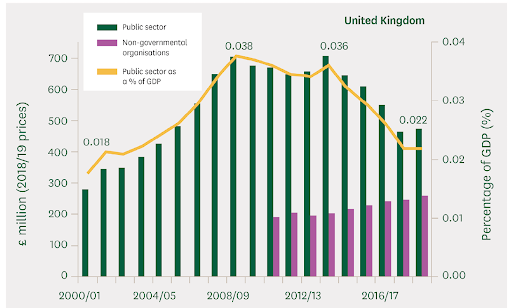
Source: UK Parliament
These figures underscore the critical need for immediate action, which the BNG framework aims to address.
Related Reading: Environmental Certification: What Is It And Why Do You Need It?
2. Definition Of “Small Sites” And The Small Sites Metric
Within the BNG framework, small sites or small developments are defined as non-major developments under the Town and Country Planning (Development Management Procedure) (England) Order 2015). They are categorised as follows:
- For residential developments: Sites with one to nine dwellings covering less than 1 hectare, or if the number of dwellings isn’t specified, sites smaller than 0.5 hectares
- For non-residential sites: Those developing less than 1,000 square metres of floor space or covering less than 1 hectare
- For industrial sites: Developments that do not involve the working of minerals or use of land for mineral-working deposits, as well as those that are not waste developments.
The BNG policy does allow for some exceptions, particularly for small-scale self-build and custom homebuilding projects.
Meanwhile, the small sites metric (SSM) is used to calculate biodiversity value to achieve biodiversity net gain for “small sites”. The SSM enables you to assess the biodiversity value of:
- Current habitats
- Habitat enhancement
- Habitat creation.
The SSM can calculate various “biodiversity units” through distinct “modules” within the metric, including:
- Area habitat units
- Hedgerow units
- Watercourse units.
You can find more information about the SSM in The Small Sites Metric (Statutory Biodiversity Metric) User Guide.
3. Small Developments Need A “Competent Person” To Conduct An SSM Assessment
Developers in charge of small sites are required to appoint a qualified individual (known as the SSM “user”) to conduct an SSM assessment using the SSM tool.
Source: European Standards
This person does not need to be an ecologist, but they do need to possess the appropriate knowledge and experience as outlined in the British Standard BS 8683:2021 – Process for designing and implementing Biodiversity Net Gain.
SSM users are expected to be sufficiently skilled in:
- Identifying habitats on the site before development
- Understanding the management needs for habitats created or enhanced as part of the post-development landscape design.
Related Reading: What Is A Construction Environmental Management Plan?
4. There Are Three Ways For Developers To Achieve BNG
Government guidelines detail three methods for developers to meet the 10% BNG requirement:
- Developers can improve and restore biodiversity directly within their development site (i.e., inside the site red-line boundary).
- If achieving full BNG on-site isn’t possible, developers can opt for a combination of on-site and off-site solutions. This option involves either enhancing biodiversity on their land outside the development area or purchasing off-site biodiversity units available on the market.
- Should on-site or combined on-site and off-site BNG not be feasible, developers must purchase statutory biodiversity credits from the government. The government then allocates the funds from these credits for habitat creation projects in England. This approach should be considered only as a last resort.
Developers can use a combination of all three strategies but must apply them in the specified sequence — known as the biodiversity gain hierarchy. This step is especially important for small site developers — who may face constraints in available land — as the biodiversity gain hierarchy is crucial for the success of their projects in obtaining planning permission.
5. BNG Offers Incentives For Developers
Whilst the BNG policy requires developers to comply with extra steps to obtain planning permission from their LPAs, the implementation of biodiversity improvement measures creates multiple opportunities for innovation, particularly for small developers.
For example, adding elements of green infrastructure or designs that support biodiversity, such as a wildflower roof, can both increase a project’s appeal and its market value. A report by global real estate firm JLL shows that buildings BREEAM certification saw an average increase in capital values of 20.6%, whilst an upgrade in EPC ratings yielded a 3.7% premium.
Meeting the BNG criteria also encourages collaboration, helping reduce the burden of achieving compliance. By involving stakeholders such as landowners, ecologists and environmental groups from the start, potential challenges can be proactively managed. Sharing resources and knowledge not only boosts the biodiversity benefits for the present project but also lays down an economic model for subsequent ventures.
Navigate The Challenges Of Biodiversity Net Gain Legislation With Veriforce CHAS
Although BNG requirements present hurdles for small development projects, they simultaneously offer chances for growth and imaginative solutions. To navigate these changes, construction and property management stakeholders should familiarise themselves with the BNG framework as well as the provisions of the Environmental Act 2021.
Stay updated with the latest trends and best practices in risk management within the energy sector by following CHAS Insights. For more practical support in addressing sustainability risks in your supply chain, explore CHAS Social Sustainability. Veriforce CHAS offers benchmarking services to evaluate your supply chains against various sustainability criteria, aiding in the enhancement of your processes.

